

Table of Contents
Antenna Selection & ERP: How to Actually Double Your Radio Repeater's Range
- Posted by:Lucky
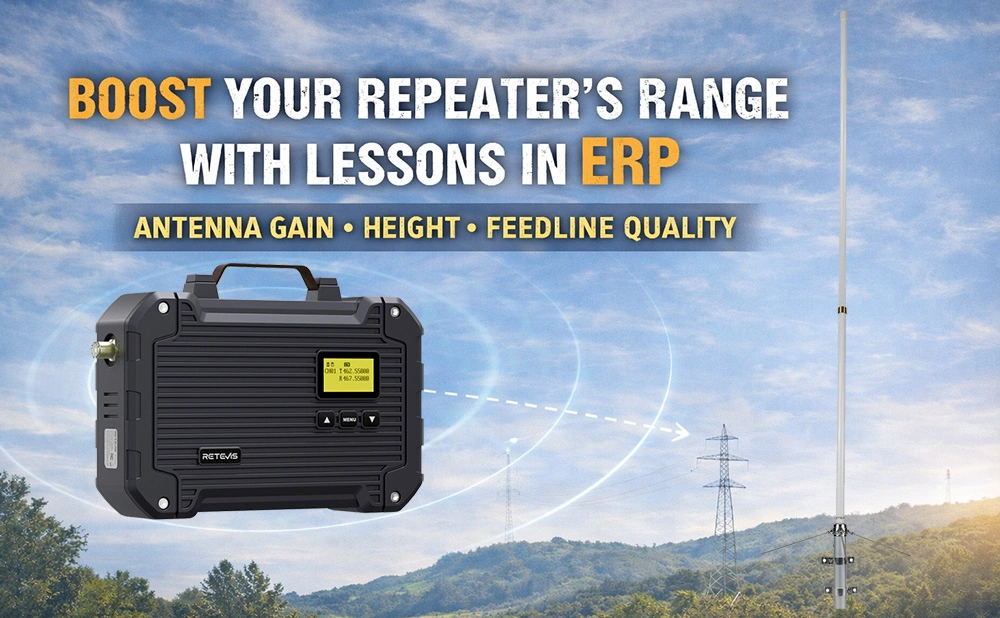
You’ve installed your repeater, connected the cables, powered it on—and the coverage still disappoints.
You’ve boosted power, but the signal still fades behind obstacles or loses strength at the edges of your intended range.
Sound familiar?
The Real Reason Your Repeater Doesn’t Reach as Far as You Expected
You see other systems achieving incredible range with similar equipment and wonder, "What am I missing?"
Here’s the truth: output power alone doesn’t define range—Effective Radiated Power (ERP) does.
And ERP is determined not just by watts, but by your antenna gain, height, and feedline quality.
Many operators—whether in public safety, business communications, amateur radio, or field deployments—unintentionally waste most of their repeater’s potential simply through poor antenna system design.
This article explains how ERP works, how to choose the right antenna for your environment, and how small system optimizations can literally double your usable range—without touching your transmitter.
Understanding ERP: The True Measure of Signal Strength
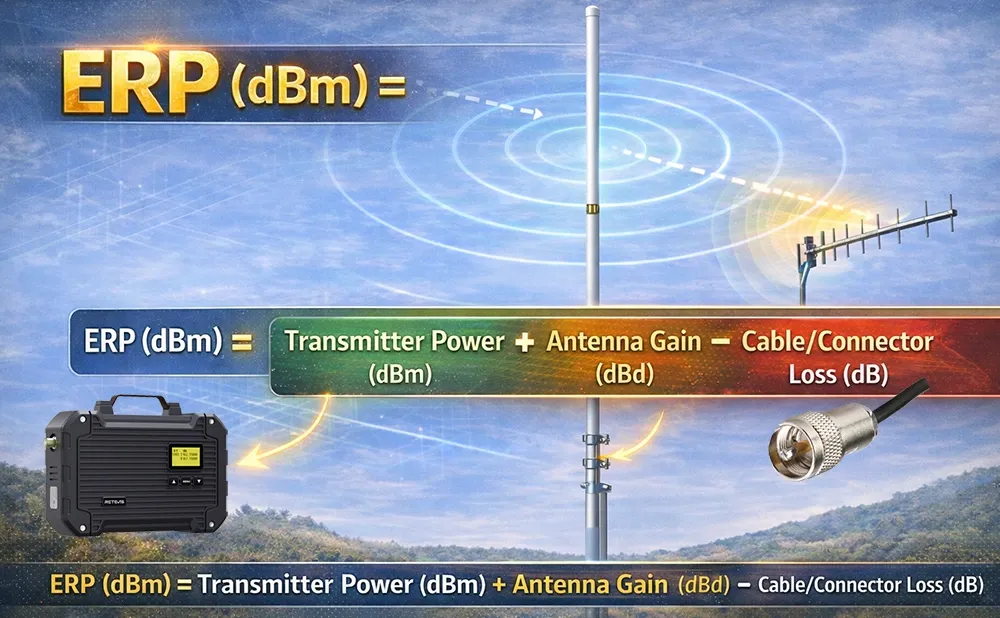
ERP (Effective Radiated Power) represents the actual strength of your transmitted signal as it leaves the antenna in a specific direction, factoring in antenna gain and system losses.
The Formula (This calculation assumes all values are in dB relative to dipole (dBd).):
ERP(dBm)=Transmitter Power(dBm) + Antenna Gain (dBd) − Cable/Connector Loss(dB)
Example:
A 25W repeater (44 dBm) → +6 dBd antenna → 2 dB total loss
(Each 3dB ≈ double the power)
ERP=44+6−2=48dBm≈63W
That means your 25W repeater effectively radiates like a 63W transmitter—simply through antenna efficiency.
Antenna Gain Isn’t Amplification—It’s Focus
Antenna gain doesn’t create new power; it redistributes existing power more efficiently—just like a flashlight beam.
A high-gain antenna focuses your energy horizontally, improving long-distance coverage at the expense of vertical spread.
|
Antenna Type |
Typical Gain |
Pattern |
Best For |
|
¼ Wave Ground Plane |
0 dBd |
Omni (spherical) |
Local coverage, varied terrain |
|
5/8 Wave Whip |
+3 dBd |
Slightly flattened |
Mobile use |
|
Collinear Omni |
+6–9 dBd |
Horizontal emphasis |
Fixed base/repeaters |
|
Directional Yagi |
+8–13 dBd |
Focused beam |
Point-to-point or hilltop links |
Pro insight:
- Use higher gain (6–9 dBd) for flat terrain or urban coverage.
- Use lower gain (0–3 dBd) for hilly or multi-level environments to maintain vertical reach.
Antenna Height: The Unsung Hero of Coverage
Power and gain mean little if your signal can’t clear nearby obstacles.
Every 3 meters (10 feet) of added height improves line-of-sight range by roughly 5–10%(depending on local topography and frequency), according to FCC and Ofcom field data.
For example:
- 3 m (10 ft) → ~8 km range
- 9 m (30 ft) → ~11–12 km range in open terrain
Why:
VHF and UHF signals travel primarily line-of-sight. Raising your antenna expands the radio horizon dramatically.
Feedline Loss: The Hidden Range Killer
Even a professional-grade repeater can underperform with poor-quality coax.
Every meter of coax cable introduces attenuation—small individually, but significant cumulatively.
|
Cable Type |
Loss @ 450 MHz (per 30 m) |
Recommendation |
|
RG-58 |
~6.5 dB |
Avoid for fixed installations |
|
RG-213 |
~3.5 dB |
Acceptable mid-range |
|
LMR-400 |
~1.5 dB |
Excellent performance |
|
½”Heliax |
<1.0 dB |
Professional systems |
Rule of thumb: Every 3 dB of loss = half your signal power lost before it even leaves the antenna.
How These Choices Multiply: Real ERP Comparison
Now, let’s put it all together.
Case A: Poor setup
- 25W repeater (44 dBm)
- +3 dBd whip antenna
- 5 dB loss (cheap coax)
→ ERP = 44 + 3 - 5 = 42 dBm ≈ 16W
Case B: Optimized setup
- 25W repeater (44 dBm)
- +6 dBd collinear antenna
- 1.5 dB loss (LMR-400)
→ ERP = 44 + 6 - 1.5 = 48.5 dBm ≈ 70W
✅ Same repeater—4× the radiated power.
That’s roughly a 6 dB improvement, which in practical terms can extend your usable range by 60–100%, depending on terrain and frequency.
That’s why experienced engineers obsess over antennas, not amplifiers.
Frequency Band and Environment: Matching the Antenna to the Job
|
Environment |
Frequency Band |
Recommended Antenna |
Typical Gain |
Mounting Note |
|
Urban area |
UHF (400–480 MHz) |
Collinear Omni |
+5–7 dBd |
Roof-mounted, clear of metal |
|
Rural/Flat terrain |
VHF (136–174 MHz) |
5/8 Wave or Yagi |
+6–10 dBd |
10m+ high mast |
|
Mountainous |
VHF |
¼ Wave |
0–3 dBd |
Peak placement |
|
Temporary/Event site |
UHF |
Compact Omni |
+3–5 dBd |
Tripod or pole mount |
In open terrain, a VHF Yagi at 12 m height can maintain reliable 20–25 km coverage at 25W ERP.
ERP vs. EIRP—Know Which You’re Using
- ERP (Effective Radiated Power): Reference to dipole (dBd)
- EIRP (Effective Isotropic Radiated Power): Reference to isotropic (dBi)
- Conversion: EIRP = ERP + 2.15 dB
For instance, a 50W ERP signal equals roughly 82W EIRP.
Some regulators (FCC, Ofcom, ETSI) specify limits using one or the other. Always confirm before deployment.
Real-World Application: Small Repeaters, Big Impact
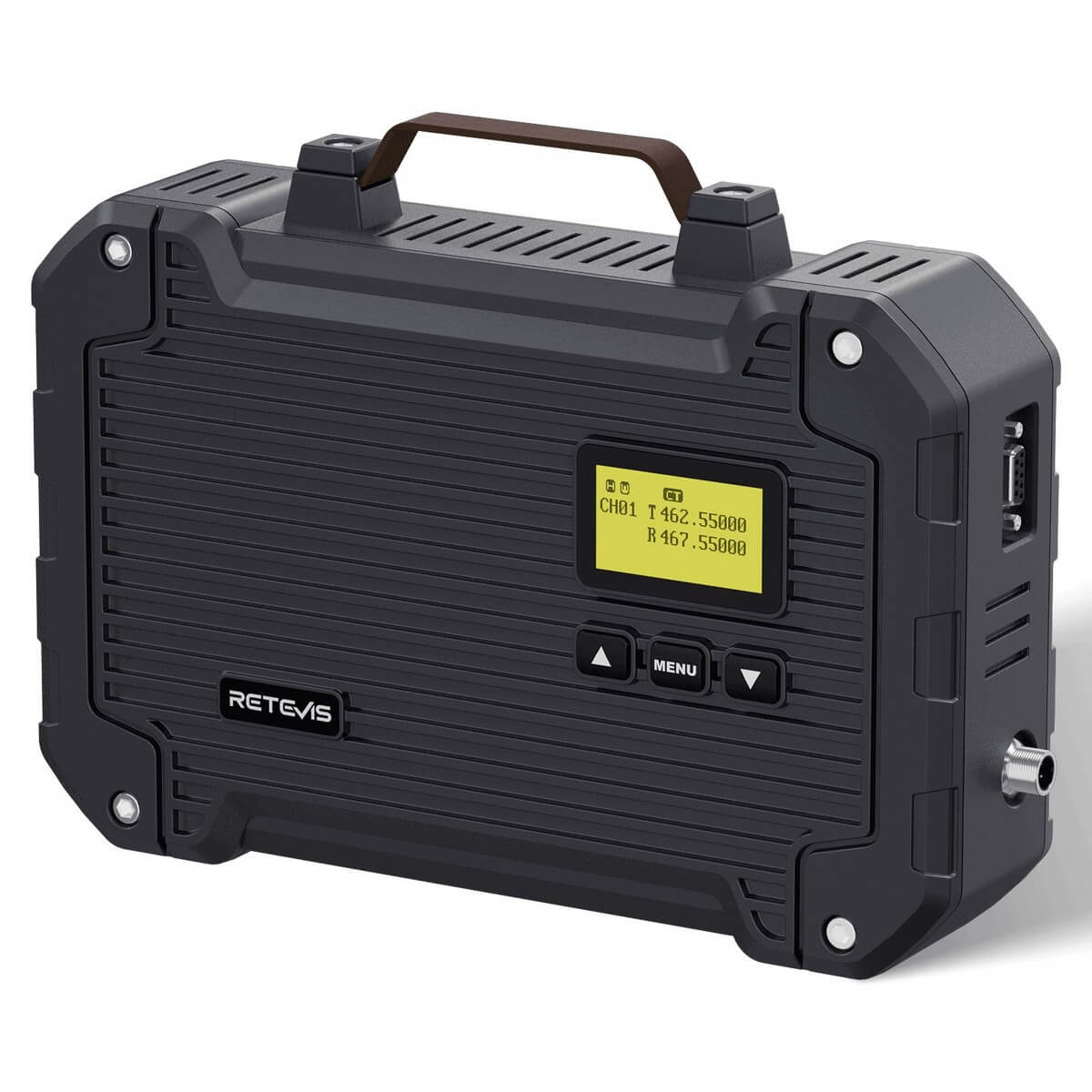
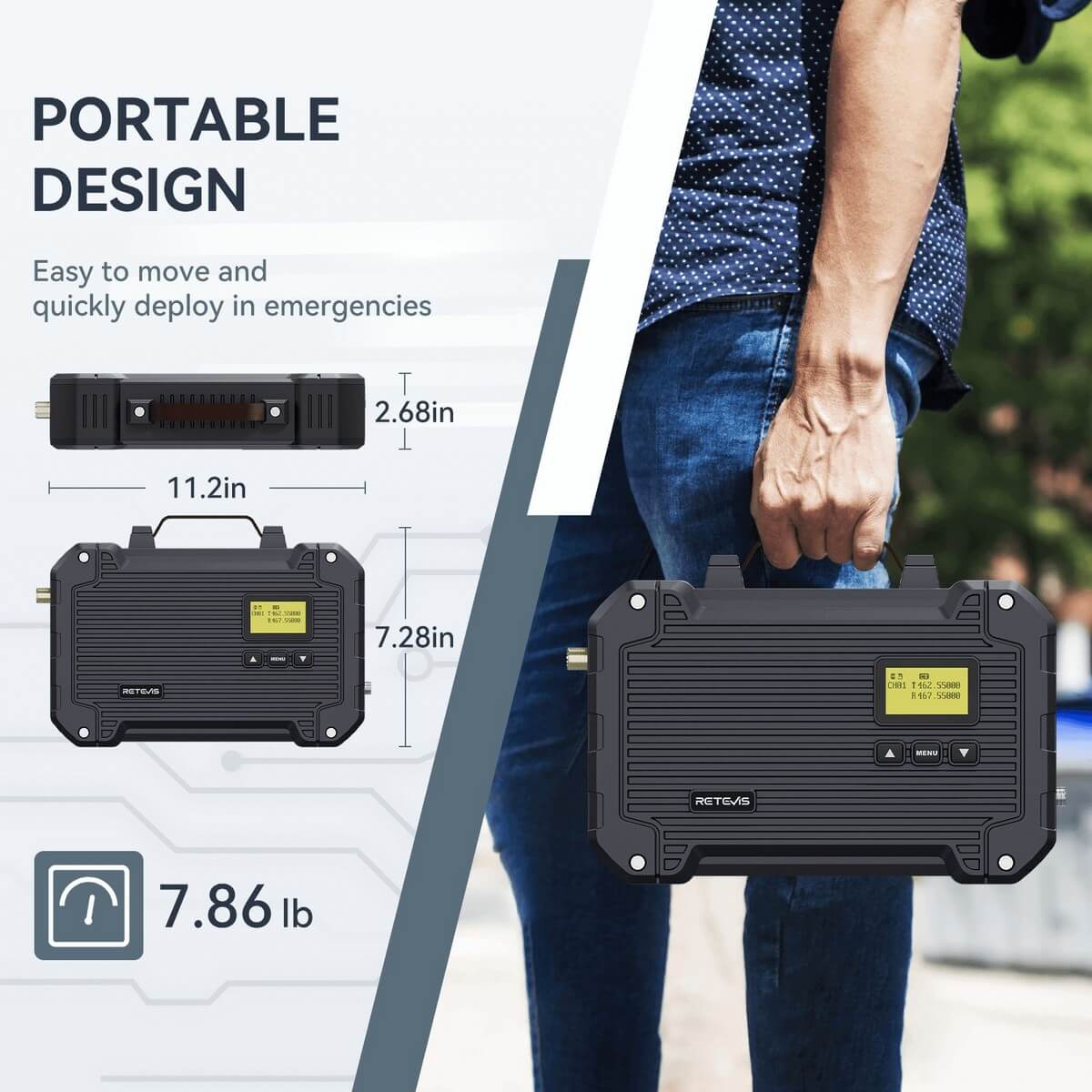
Portable repeaters—like Retevis RT97L (25W)—demonstrate how a well-matched antenna system can perform like much larger fixed stations.
When paired with a +6 dBd antenna and low-loss coax, systems like this can achieve effective ERP around 50–70W, providing dependable communication across campsites, events, or temporary emergency networks.
It’s not the repeater itself—it’s how efficiently you radiate its power.
Final Takeaways
- ERP defines range—not wattage.
- Antenna height and gain are more influential than output power.
- Feedline quality can make or break your system.
- Optimizing your antenna setup can double or even triple your real-world range—without buying a bigger repeater.
In radio systems, efficiency beats brute force. Smart design always outperforms raw power.
Whether you’re supporting a rural communication link, coordinating event teams, or running an emergency network, your antenna system determines whether your 25W repeater behaves like a 10W toy or a 70W powerhouse.







 Google
 Amazon
Comments
No data Yet