These waterproof and floating radios are loud, easy to use, perfect for kayaking with family and friends, or just around the pool deck. The only con is a micro usb vs usb-c. However because they come with the charging cradle, just leave it plucked in and drop the radios in.
Was nice to back in the boat while communicating with my wife. No yelling. No regrets. 😁
For the money they work well. A lot of good features. Able to talk to other brand radios just fine. We used them in the Gulf of Mexico while swimming to talk to family on the beach. The radios were submerged often. The only issue we encountered was the mic holes would have to be blown out from time to time so we could be heard when talking. Battery life seems good as we charged every nught but they were never more than half dead. The NOAA radio has somewhat weak reception but I don’t buy them for that feature although it could be useful.
Use the original batteries provided in the box, and they will float!I thought I'd be smart and use my own higher capacity batteries, but an extra 10 g of weight (two American nickels) compromises the bouyancy. My batteries added 30 g, so my radios became bricks.If you're worried about the batteries dying on a trip, buy an extra set of the originals. Be sure they're the same voltage and each weigh 20 g or less.
Great for what I wanted it for, so easy a child could use it. Can hear each other from 1 person inside the house and another inside the shop. (Works well with obstruction)
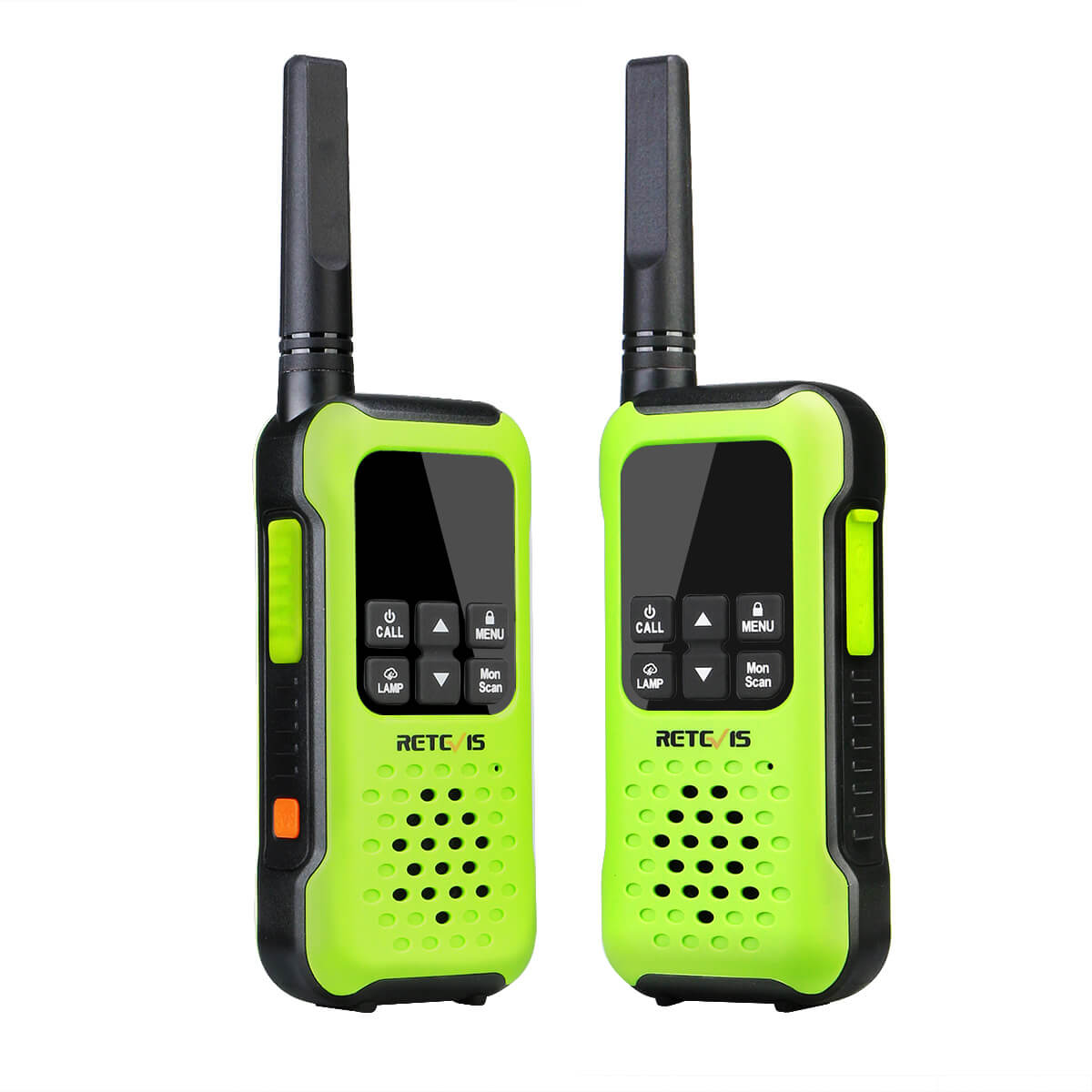
Over the summer my family did a lot of boating and swimming by the lake and wanted to be able to communicate between everyone out on the lake and people back at the shore. Since accidents happen, especially with kids, we wanted waterproof radios that floated. These did the trick: with the factory-installed batteries (I didn't try any others), they'd float to the surface in a freshwater lake and would function without any leaks or issues. Even with extensive submergence and being tied to a rope and dragged behind a kayak for an hour or so, there were no leaks. As a handy feature, whenever the radio is immersed in water the white flashlight lamp flashes on and off to aid in locating it even in the dark. Charging is simple: just plop them into the provided dock that you can plug into any USB power supply. Minor nitpick: the battery indicator on the radios constantly shows the "charging" animation whenever they're charging on the dock, even when the batteries are fully charged, so there's no way of knowing how full they actually are. They easily had a range of more than 4400 feet (>0.8 miles) over the lake's surface, even with one of the radios inside a house, when the radios were set to 2W of power. At that range, there was virtually no static and voices came through crystal clear. I didn't test them at 0.5 W. The user interface is simple and easy to navigate with the on-screen menu being easy to navigate. Some of the settings may not be intuitively clear as to what they do, but the manual explains them. The radios work on standard FRS frequencies and are completely compatible with other FRS radios. They support CTCSS tone and DCS code squelch (often misleading called "privacy codes", as they don't offer privacy, but allow you to only hear transmissions from others using the same tone/code), and if you set the radio to use the same channel and tone/code combination (or set the tone/code to "0" to turn it off entirely) they interoperate with any other FRS-standard radio. The tones/codes are selected from the list ranging from 0 to 121, but the manual does not specify which actual tones/codes (e.g. 127.3 Hz, or DCS223) correspond to those numeric values. After contacting Retevis and a few emails back and forth where I tried to explain exactly what I wanted to know (evidently there was some minor misunderstandings, but politeness and persistence paid off), they sent me a table showing which tones/codes match each numeric value. It turns out they use the "Common" values used by Motorola, Uniden, and many other manufacturers. You can find a table listing the Common values and what they correspond to on radios by other manufacturers by searching for "FRS/GMRS Privacy Codes Demystified". The radios are a bit bulky (since they need the extra bulk to be able to float) but my 6 and 9 year old kids were able to hold and use them with zero issues. The radios are also capable of receiving NOAA weather radio signals, which was handy, but a bit of a niche feature. They can be set to automatically switch to the weather radio signal when an alert is issued, but they don't allow one to set SAME codes or locations, so if you set them to use the weather alert then any time they receive any alert (even for one outside of your region) they'll switch to the weather radio. I tested but did not use the "SOS alarm" feature (which sounds a loud alarm, flashes a red light that is not otherwise able to be turned on, and transmits the alarm signal over the radio). The built-in white flashlight is basic and not terribly bright, but is handy if you already have the radio in-hand and don't want to fumble around for a proper flashlight. In short: for license-free FRS use where contact with or submersion in water is a possibility, these are great. I recommend them.
Worked surprisingly well. I had originally bought the Motorola walkie-talkie for car trip, but it would not transmit properly. The Retevis works without delay and was able to pick up calls and speech clearly. Battery lasts for days on standby. Save yourself the money and get these instead of the Motorola's version of the same thing.
I got these to use at work between the warehouse and the showroom floor. These work very well would buy agaon
Worked around 3/4 of a mile from each other could still hear clear as day seem super durable and well worth the money!!



 Google
 Amazon