

Table of Contents
Comparing Retevis RB48 and RB48 Plus: Which Channels Can Communicate?
- Posted by:Ilsa
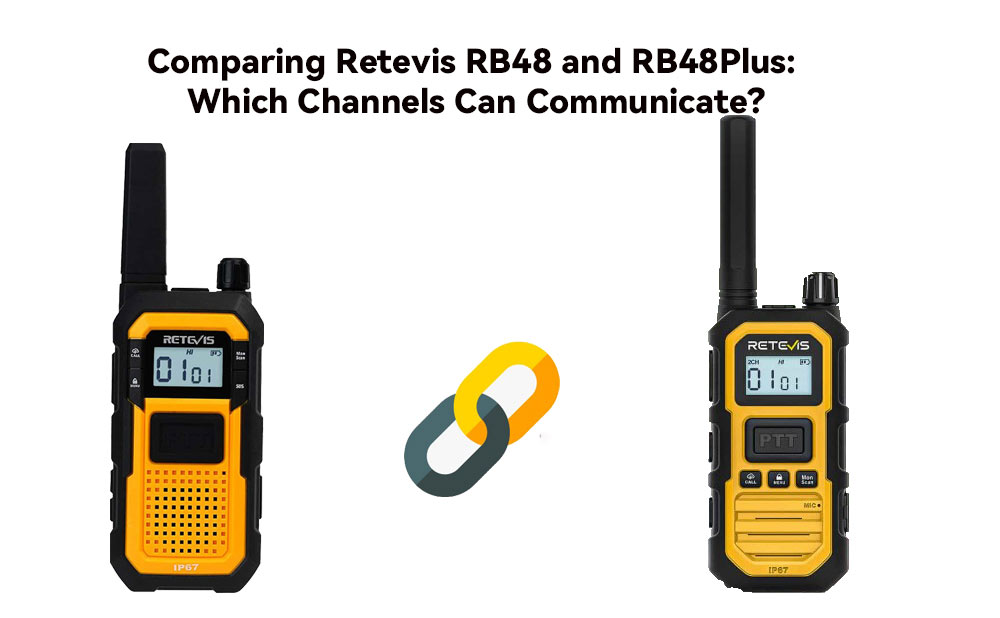
When using different models of walkie-talkies, matching the channel settings is essential for reliable communication. The Retevis RB48 and Retevis RB48 Plus are both popular two-way radios, but are their channels compatible?
In this guide, we compare the Retevis walkie talkie channel frequencies, CTCSS/DCS settings, and factory-default configurations to identify which channels the RB48 and RB48 Plus can use together.
Understanding Retevis RB48 and RB48 Plus Compatibility
The RB48 and RB48 Plus can communicate when both radios use the same:
- Receive (RX) frequency
- Transmit (TX) frequency
- CTCSS/DCS code
A matching frequency alone is not always enough. CTCSS/DCS settings filter incoming signals based on the programmed tone or code. If these settings differ, two radios may not hear each other even when they operate on the same frequency.
How We Compared the RB48 and RB48 Plus Frequencies
The compatibility analysis is based on the factory-default channel configurations provided in the official Retevis product documentation. We compared the RX/TX frequencies and CTCSS/DCS settings for each channel on the Retevis RB48 and RB48 Plus.
A channel is considered fully compatible when the frequency and CTCSS/DCS settings match. If the frequency matches but the CTCSS/DCS code differs, the channel requires adjustment before communication.
Retevis RB48 Channel Frequency Chart
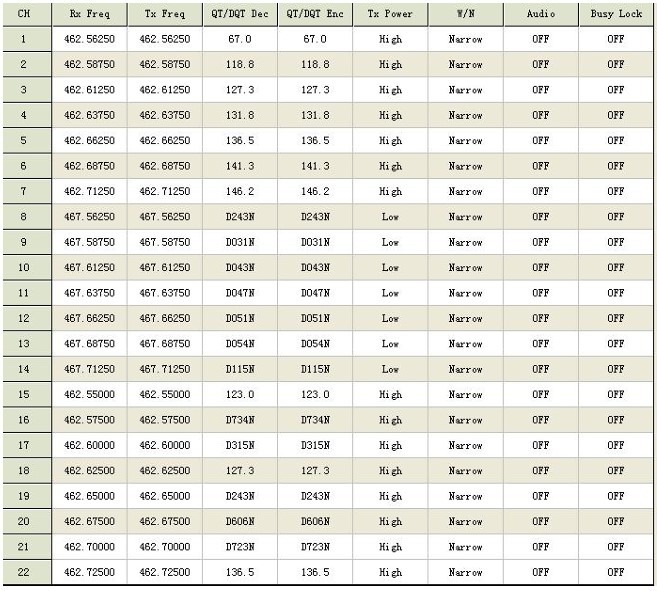
The RB48 factory-default channel configuration shows the operating frequency and corresponding CTCSS/DCS settings for each channel.
RB48 Frequency Chart
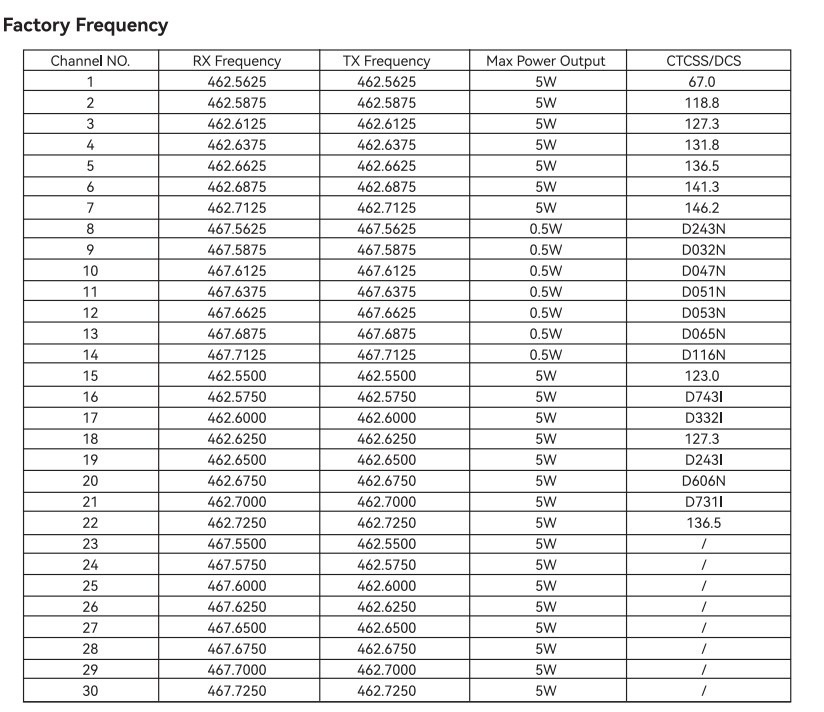
The RB48 Plus uses a similar channel configuration, but some frequency or encoding settings differ from the RB48.
RB48 Plus Frequency Chart
RB48 vs. RB48 Plus Channel Compatibility
The following table summarizes the factory-default configurations of the two radios:
|
Channels |
Frequency |
CTCSS/DCS |
Compatibility |
|
1–8 |
Match |
Match |
✅ Fully compatible |
|
9–13 |
Match |
Different |
⚠️ Requires adjustment |
|
14–22 |
Match |
Match |
✅ Fully compatible |
|
23–30 |
Different settings |
Different/varies |
❌ Not compatible by default |
This table reflects the factory-default configurations. Actual compatibility depends on the settings programmed into each individual radio.
Which Channels Can RB48 and RB48 Plus Communicate On?
Channels 1–8: Fully Compatible
Channels 1–8 use matching RX/TX frequencies and CTCSS/DCS settings on the RB48 and RB48 Plus.
You can use these channels for direct communication between the two models without additional programming.
Channels 14–22: Fully Compatible
Channels 14–22 also have matching frequency and CTCSS/DCS configurations.
These channels provide another group of factory-compatible options when using RB48 walkie talkies and RB48 Plus radios together.
Which Channels Require CTCSS/DCS Adjustment?
Channels 9–13
On channels 9–13, the RB48 and RB48 Plus use the same frequency but different CTCSS/DCS settings.
Because the codes do not match, the radios may not hear each other's transmissions under the default configuration.
To use these channels together, manually set the CTCSS/DCS code on both radios to the same value.
Note: CTCSS/DCS is sometimes called a “privacy code,” but it does not encrypt the transmission or provide true privacy. It primarily controls which signals open the radio's squelch.
Which Channels Are Not Compatible by Default?
Channels 23–30
Channels 23–30 have differences between the RB48 and RB48 Plus in their factory configurations, including frequency or encoding settings.
Therefore, these channels should not be considered directly compatible without reprogramming the radios.
How to Check Retevis Walkie-Talkie Frequency Compatibility
When checking whether two Retevis radios can communicate, follow these steps:
- Check the frequency band of both radios.
- Compare the RX/TX frequency for the selected channel.
- Check the CTCSS/DCS settings on both radios.
- Match the CTCSS/DCS code if the radios use different settings.
- Test communication between the radios before using them in the field.
Do not rely on the channel number alone. The same channel number can represent different programmed frequencies or codes on different radio models.
FAQ: Retevis Walkie-Talkie Frequencies and Compatibility
Are all Retevis walkie-talkies compatible with each other?
No. Retevis walkie-talkies are not automatically compatible simply because they are made by the same brand. Compatibility depends on factors such as frequency band, RX/TX frequency, CTCSS/DCS settings, and radio configuration.
Can RB48 and RB48 Plus communicate with each other?
Yes. The Retevis RB48 and RB48 Plus can communicate on channels with matching frequency and CTCSS/DCS settings. By default, channels 1–8 and 14–22 are compatible.
Where can I find the Retevis RB48 Plus manual?
The Retevis RB48 Plus manual provides detailed information about channel frequencies, CTCSS/DCS settings, and radio operation. Refer to the documentation for the specific radio version before changing channel parameters.
Is the RB48 Pro compatible with RB48 and RB48 Plus?
The RB48 Pro has its own channel configuration, so compatibility should be determined from its specific frequency and CTCSS/DCS settings rather than assuming that all RB48-series radios use identical configurations.
What is a Retevis channel frequency list used for?
A Retevis frequency list or radio frequency chart shows the programmed frequency and related settings for each channel. It can help determine whether two radios can communicate and which settings need to be adjusted.
Conclusion
The Retevis RB48 and RB48 Plus can communicate directly on channels 1–8 and 14–22 using their factory-default settings. Channels 9–13 require matching CTCSS/DCS settings, while channels 23–30 are not compatible by default.
By checking the Retevis channel frequency list, RX/TX frequencies, and CTCSS/DCS settings, users can quickly determine whether different Retevis radios are configured for reliable communication.
Leave a Reply








 Google
 Amazon
Comments
No data Yet