

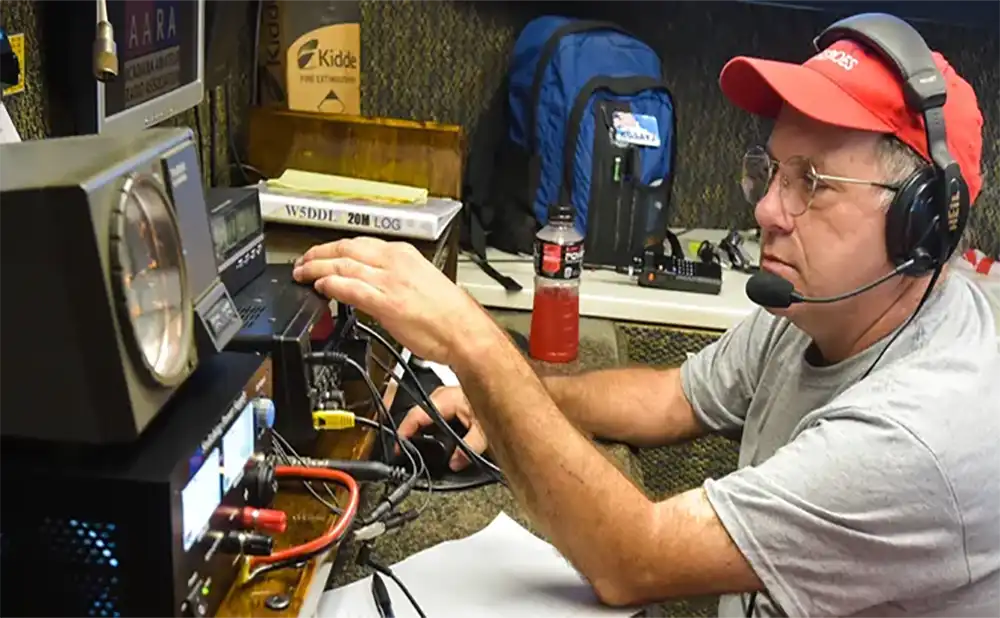
Soon, if you haven’t done so already, you’ll be thinking about upgrading. You have many more frequencies to use on the high-frequency (HF) bands, as shown in the following table. A complete chart of the U.S. frequency and mode privileges for all license classes is available from the American Radio Relay League (ARRL).
| Band | Frequencies (in MHz) | Mode |
| 160, 60, 30 meters | All amateur privileges | |
| 80 meters | 3.525–3.600 | CW, RTTY, data |
| 3.800–4.000 | CW, phone, image | |
| 40 meters | 7.025–7.125 | CW, RTTY, data |
| 7.175–7.300 | CW, phone, image | |
| 20 meters | 14.025–14.150 | CW, RTTY, data |
| 14.225–14.350 | CW, phone, image | |
| 15 meters | 21.025–21.200 | CW, RTTY, data |
| 21.275–21.450 | CW, phone, image | |
| 17, 12, 10 meters | All amateur privileges | |
| Above 50 MHz | All amateur privileges |
Common ham radio Q signals
Hams use three-letter Q signals on every mode and even in face-to-face conversation. Here are the Q signals most commonly used in day-to-day operation. Each signal can be a question or an answer, as shown in the Meaning column. A complete list of ham radio Q signals, including those used on nets and repeaters, is available via the AC6V Operating Aids web page.
| Q Signal | Meaning |
| QRL | Is the frequency busy? The frequency is busy. Please do not interfere. |
| QRM | Abbreviation for interference from other signals. |
| QRN | Abbreviation for interference from natural or human-made static. |
| QRO | Shall I increase power? Increase power. |
| QRP | Shall I decrease power? Decrease power. |
| QRQ | Shall I send faster? Send faster (__words per minute [wpm]). |
| QRS | Shall I send more slowly? Send more slowly (__wpm). |
| QRT | Shall I stop sending or transmitting? Stop sending or transmitting. |
| QRU | Have you anything more for me? I have nothing more for you. |
| QRV | Are you ready? I am ready. |
| QRX | Stand by. |
| QRZ | Who is calling me? |
| QSB | Abbreviation for signal fading. |
| QSL | Did you receive and understand? Received and understood. |
| QSO | Abbreviation for a contact. |
| QST | General call preceding a message addressed to all amateurs. |
| QSX | I am listening on ___ kHz. |
| QSY | Change to transmission on another frequency (or to ___ kHz). |
| QTH | What is your location? My location is ____. |
The HF bands are by far the most popular bands in the amateur service. Local contacts and world-wide propagation are all possible at almost anytime with careful selection of the right frequency for the time of day, time of year, and current state of the sunspot cycle. For specific characteristics of each band, click on the links below.
The 3.5, 7, 14, 21 and 28MHz bands are the bands where contests can be found. The 10, 18 and 24MHz bands, also known as the WARC bands, are kept free of contest activity by international agreement, which now also includes the 5MHz band.
How to Choose the Best HF Frequencies for Communication?
Choosing the right HF band frequency depends on several factors:
- Time of day: Lower bands such as 40 meters and 80 meters often work well at night, while higher bands like 15 meters and 10 meters are more dependent on daylight conditions.
- Solar activity: The sunspot cycle strongly affects HF propagation and determines which bands are most effective.
- Communication distance: Lower HF bands are often better for regional communication, while 20 meters, 15 meters, and 10 meters are popular for long-distance DX contacts.
Understanding these factors helps operators select the most suitable popular HF frequencies for their communication goals.
FAQ About HF Ham Bands and Frequencies
What frequency is HF?
HF (High Frequency) refers to the 3 MHz to 30 MHz frequency range. It is commonly used for amateur radio, aviation, maritime communication, and long-distance radio services.
What are the main HF bands in ham radio?
The main ham radio HF bands include 80m, 60m, 40m, 30m, 20m, 17m, 15m, 12m, and 10m bands. Each band has different propagation characteristics.
What are the best HF ham frequencies for beginners?
For many beginners, the 40 meter band frequencies and 20 meter band frequencies are popular choices because they provide reliable communication opportunities in many conditions.
Why do HF frequencies support long-distance communication?
HF signals can travel thousands of miles because they can reflect from the ionosphere, allowing communication beyond normal line-of-sight range.
Summary
There is a variety of different ham radio bands that can be used within the MF and HF portions of the radio spectrum. By choosing the correct amateur band or allocation, it is possible for a radio amateur to maximise his opportunity of making the sort of contacts he or she requires. For those ham radio enthusiasts, a good knowledge of the properties of each of the ham bands is essential, and this should be combined with up to the minute information about the state of the amateur bands and the stations that are active. Using all of this information, along with skill and experience can enable contacts to be made with many rare and interesting ham radio stations.




 Google
 Amazon
Comments
No data Yet