

Table of Contents
Why Emergency Communication Fails on Large Construction Sites—and How Radios Fix It
- Posted by:Retevis
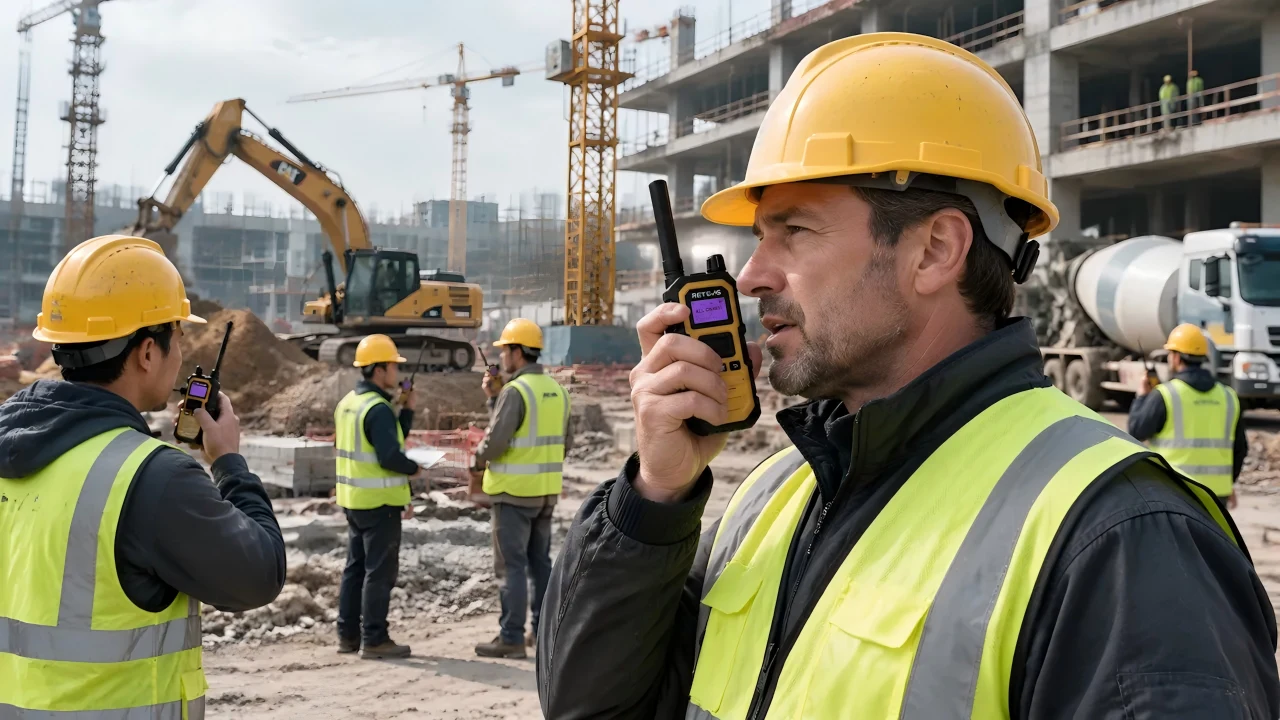
Large construction sites are difficult communication environments by nature. Work areas are spread out, machinery noise is constant, and multiple teams may be operating at the same time across different zones. Crane crews, vehicle operators, safety officers, subcontractors, supervisors, and access control staff all need to stay informed, but they are rarely standing in the same place.
In these conditions, communication delays can quickly become a safety issue. A hazard in one area may need an immediate response from people in another. A supervisor may need to stop movement near a lift zone. A safety officer may need to coordinate access for emergency assistance. If information moves too slowly, even a well-planned response can break down under pressure.
This is why communication should be treated as part of the safety system, not just a convenience. On a large jobsite, emergency coordination depends not only on procedures, but on how fast the right people can hear the same message and act on it.
Why One-to-One Communication Is Not Enough
Many construction teams still rely heavily on phones for part of their coordination. Phones are useful in some situations, but they are not ideal for fast-moving emergencies on large sites.
The biggest limitation is speed. Calling people one by one takes time, especially when several roles need to be involved at once. If a supervisor has to contact site security, then a lifting team, then a safety lead, the delay adds up. During an active incident, that delay may affect containment, access control, or evacuation timing.
There is also the problem of visibility. A worker may not hear or feel a phone ring in a noisy environment. Gloves, tools, machinery, and task focus all make phone use less practical on site. Even if someone answers, one-to-one communication does not automatically create shared awareness across the teams that also need the information.
That is the deeper problem: emergencies on large construction sites are rarely handled by a single person. They require multiple people to respond in a coordinated way. If only one person hears the message at a time, the response remains fragmented.
How Group Radio Communication Works on a Construction Site
Group radio communication solves this by changing how information moves. Instead of passing a message through separate calls, one transmission can reach multiple people instantly.
On a construction site, this usually means a supervisor or team lead can use a two-way radio to send a message to a defined group. That group may be a lifting team, ground crew, logistics staff, safety personnel, or a broader site-wide channel depending on the situation. The message is received at the same time, which means people can respond with a shared understanding of what is happening.
This becomes even more useful when teams are organized into channels or talk groups. Daily operations may use separate channels to avoid congestion, while urgent messages can be escalated across teams when needed. For example, a vehicle movement issue may begin on a logistics channel, but if it creates a wider hazard, the information may need to move quickly to site supervision and safety coordination.
In this way, radio communication supports both normal coordination and emergency escalation. It creates a faster path from detection to awareness to action.
Radio Functions That Support Faster Emergency Response
Not every radio feature matters equally on a large jobsite. The most useful functions are the ones that reduce delay, improve clarity, and support fast decisions under pressure.
Push-to-talk communication
Push-to-talk, or PTT, is the foundation of radio speed. There is no need to dial, wait for a connection, or unlock a device. A worker presses one button and speaks immediately. In an emergency, that simplicity matters.
One-to-many calling
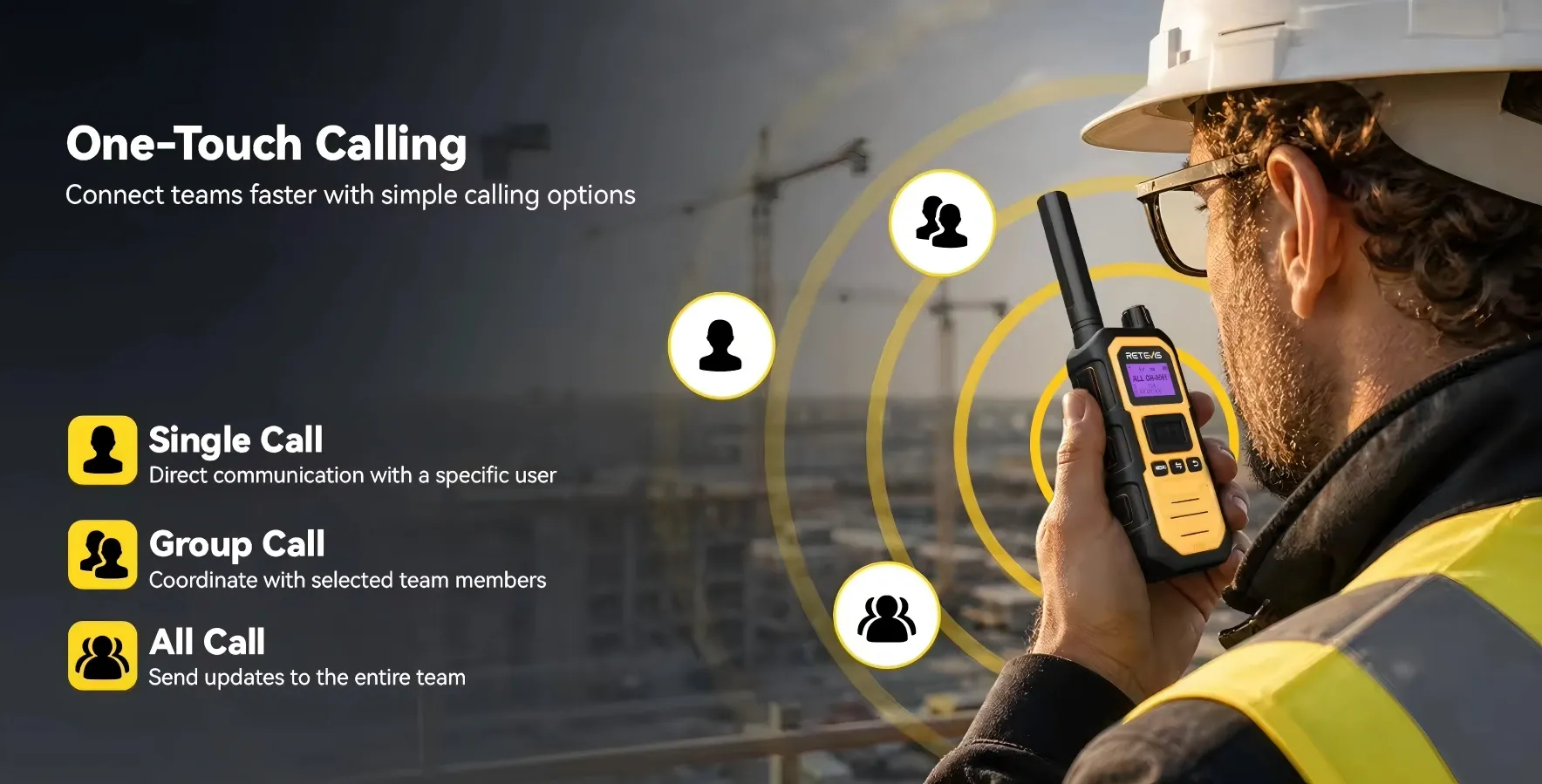
This is one of the biggest advantages over phones. A single message can reach several people at once, which reduces the risk of information being delayed, repeated incorrectly, or passed on too late. For emergency coordination, shared awareness is often more important than private conversation.
Dedicated channels
Large construction sites usually involve several functions operating at the same time. Separate channels can help keep normal site traffic organized while allowing specific teams to communicate without constant interruption. This becomes especially valuable when one area is dealing with an urgent issue while the rest of the site remains active.
Emergency alarm features
Emergency alert functions can help draw immediate attention to a serious issue. On a busy jobsite, voice traffic alone may not be enough to signal priority. An emergency alarm helps cut through routine communication and makes it clear that immediate attention is required.
Clear audio in noisy conditions
Construction sites are full of sound—engines, reversing alarms, metal impact, wind, and machinery. Radios used in these environments need strong voice intelligibility, not just volume. If a message is loud but unclear, it still creates delay.
Durable design
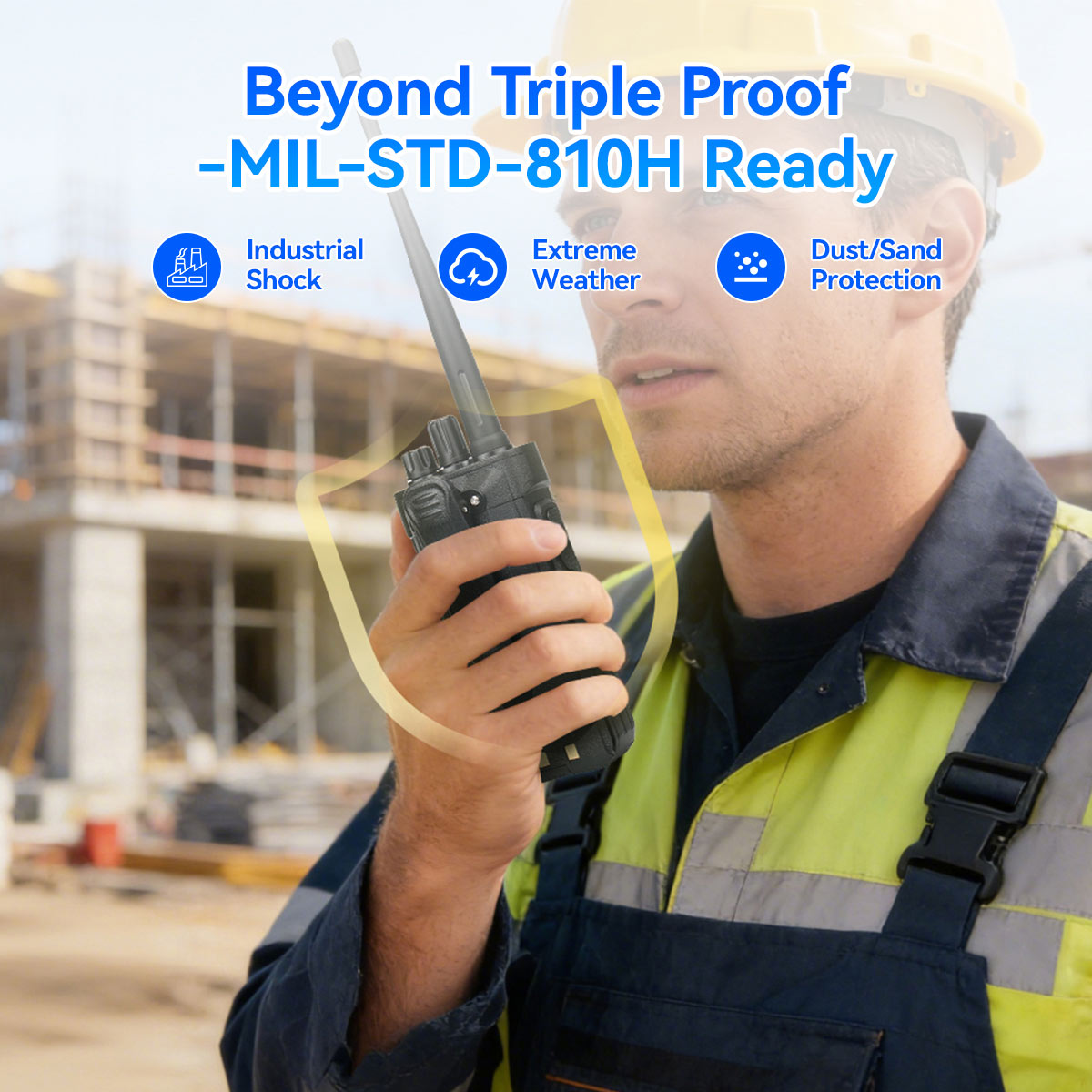
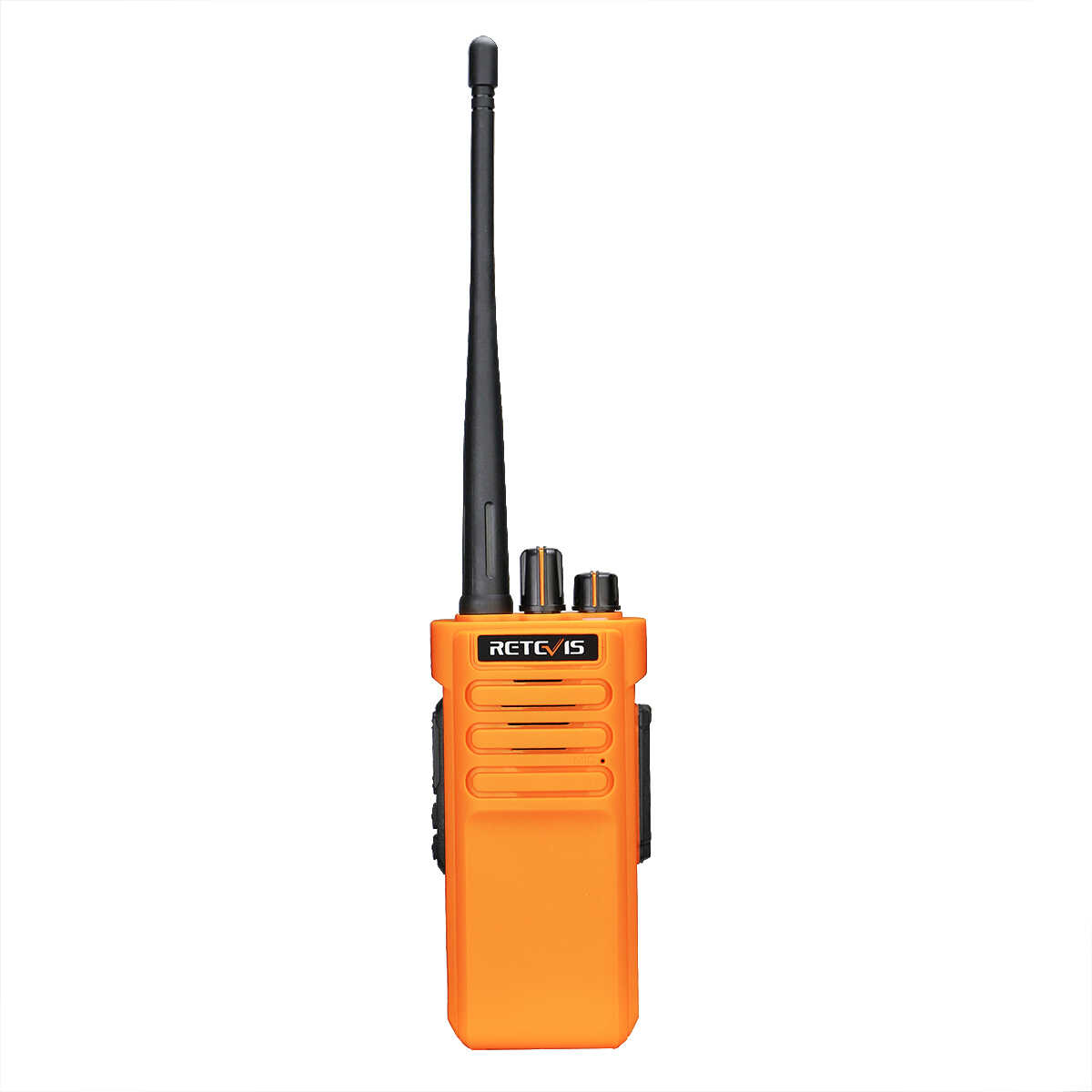
A radio used on a jobsite has to survive real working conditions: dust, drops, vibration, weather exposure, and heavy daily handling. Durability is not just about equipment lifespan. In a safety context, it is about whether the communication tool is still usable when it matters.
Three Construction Scenarios Where Coordinated Communication Matters
The value of coordinated communication becomes clearer when viewed in real site situations.
1. Worker injury or falling object risk
Imagine a worker is injured near a scaffold zone or a falling object risk is reported overhead. The first person aware of the hazard may need to alert nearby workers, site supervision, and safety personnel immediately. With radios, one transmission can stop movement in the area, request assistance, and trigger the next response steps without waiting for separate phone calls.
2. Crane and vehicle coordination
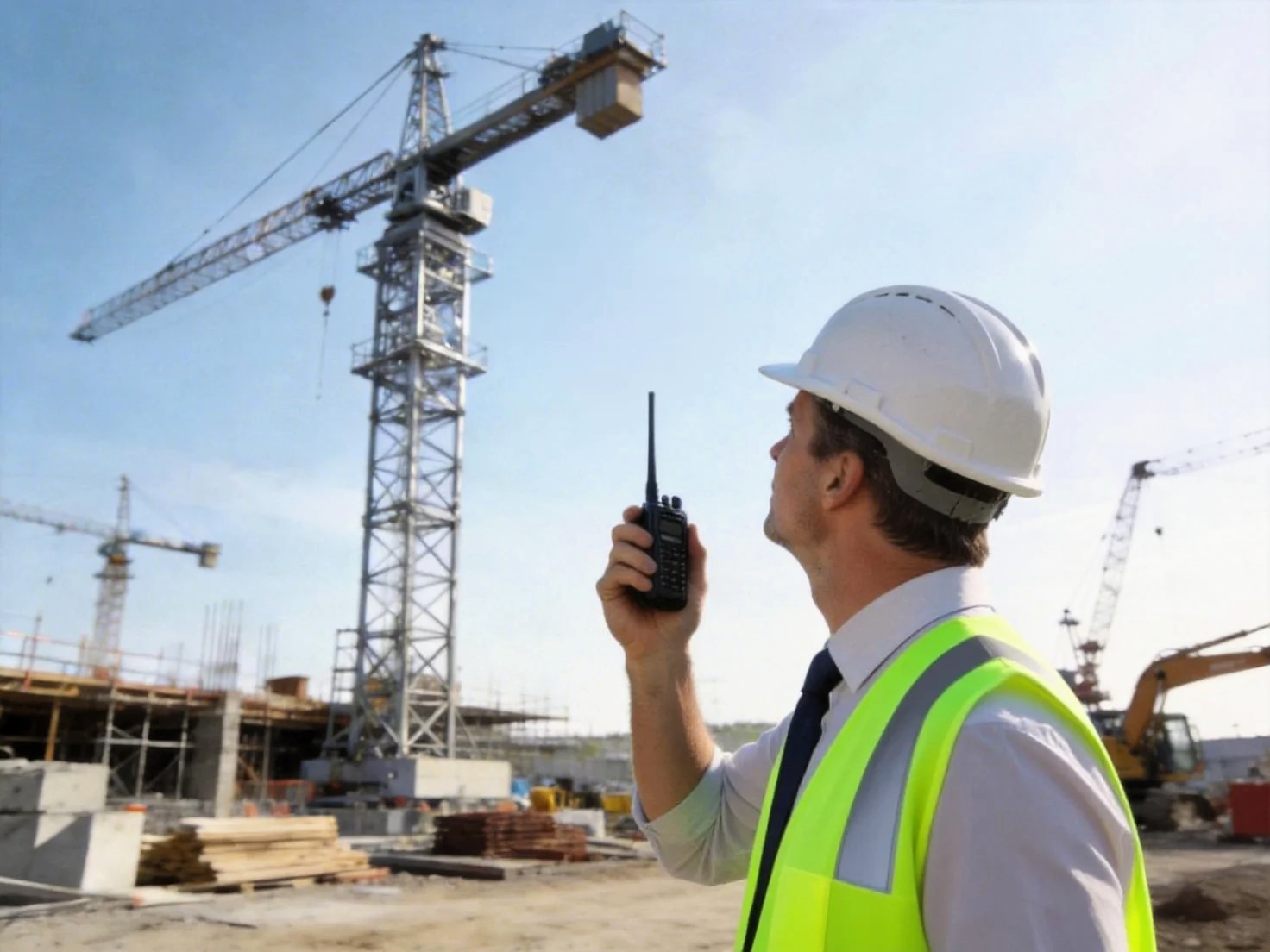
Large sites often have cranes, forklifts, trucks, and ground crews moving at the same time. If vehicle access conflicts with a suspended load path, the response must be immediate. Coordinated radio use allows lifting teams, traffic marshals, and supervisors to pause movement, confirm positions, and prevent escalation before it becomes an incident.
3. Fire, electrical issue, or evacuation
In a fire or electrical emergency, communication has to move fast across multiple layers: the person reporting the incident, local area supervisors, site safety leads, and possibly gate or access personnel. Radios allow evacuation instructions, hazard location updates, and route control messages to be shared in real time. This supports a more organized response and reduces confusion during a high-stress moment.
How to Choose a Radio System for Large Construction Sites
Choosing a communication system for a large site is not only about buying radios. It is about evaluating whether the whole setup supports the site’s operating reality.
Coverage is the first consideration. The system has to support the physical size and layout of the project, including building structures, vertical work areas, and potential signal obstacles.
Capacity also matters. A small team can work on a simple channel structure, but a larger site may need multiple teams, channels, or talk groups operating at once without creating confusion.
Team structure should shape communication design. Safety, logistics, lifting, access control, and supervision may all need different communication patterns. A good radio system should match that structure rather than forcing every message into one crowded stream.
Battery life is critical for long shifts. If radios cannot reliably support a full workday, emergency preparedness suffers. Durability, ease of use, and audio clarity should also be treated as core safety criteria, not optional extras.
Finally, the communication system should fit the site’s emergency procedures. Radios do not replace safety plans, but they help those plans function in real time. The most effective setup is one that supports how the site already organizes response roles, escalation paths, and operational control.
Conclusion: Emergency Response Depends on Shared, Timely Communication
On large construction sites, emergencies rarely fail because no one cares. They fail because the right information does not reach the right people quickly enough.
That is why group radio communication plays such an important role in site safety. It reduces information delay, improves shared awareness, and helps multiple teams respond in a more coordinated way. In noisy, spread-out, high-risk environments, those advantages can make a meaningful difference.
Radios are not a substitute for formal safety procedures, training, or supervision. But when combined with a strong safety system, they help turn plans into action faster. And on a large construction site, faster shared communication is often what makes effective emergency response possible.
Leave a Reply



 Google
 Amazon
Comments
No data Yet