

Table of Contents
How to choose the four working modes of Retevis L2 POC Radio
- Posted by:JJ
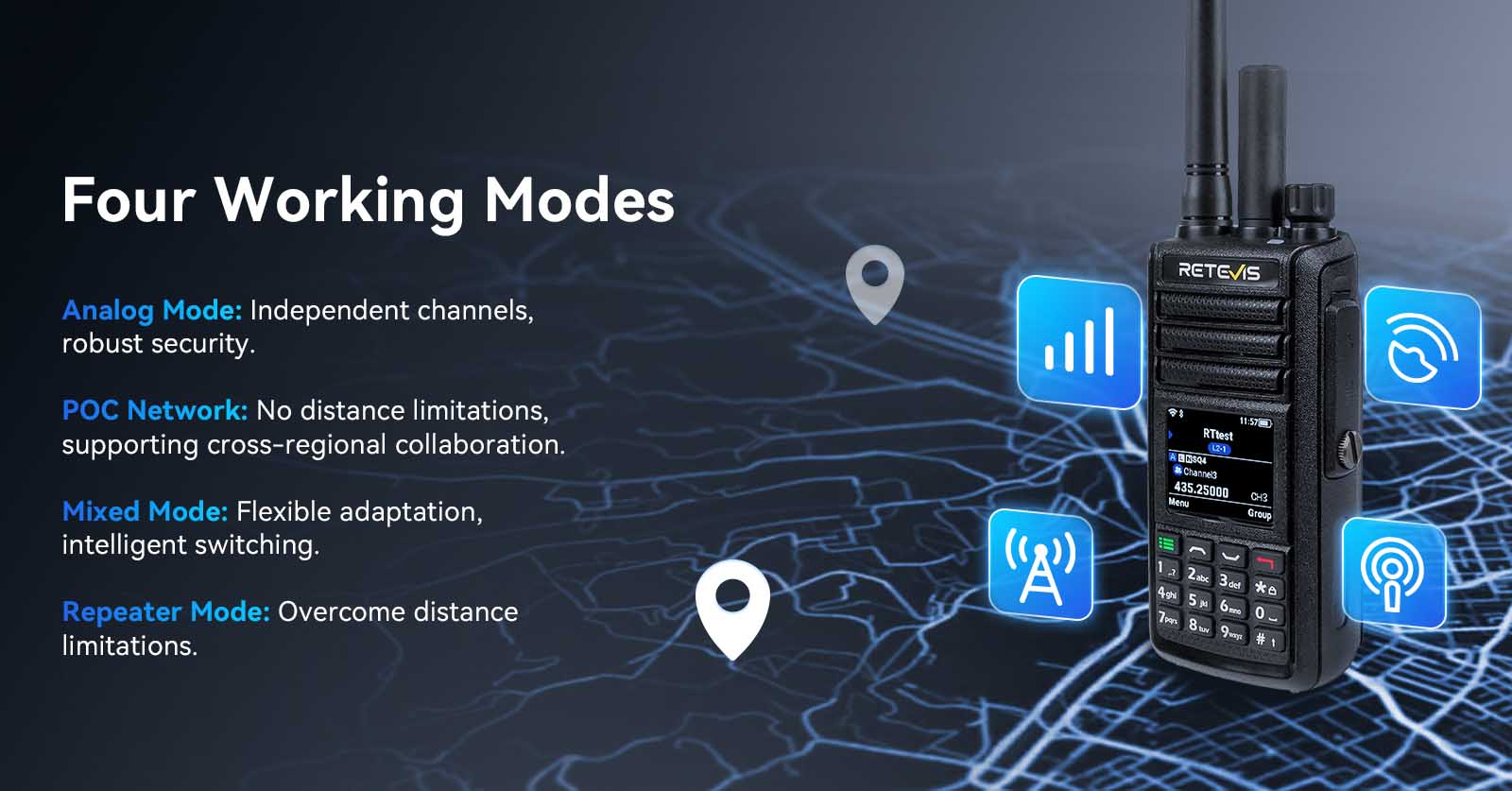
The Retevis L2 POC Radio is a robust and flexible communication tool engineered for industries like logistics, transportation, security, and emergency response. Transcending the limitations of traditional walkie-talkies, it integrates four advanced operating modes to ensure seamless communication in any environment. This guide breaks down each core mode and its optimal application scenarios to help you make the precise choice for enhanced team efficiency.
A Complete Guide to the L2 POC Radio's Core Modes & Applications
To meet the complex communication needs of various sectors, the Retevis L2 POC Radio offers diverse operating modes, each optimized for specific use cases. Here is a detailed explanation of its four primary modes and their typical applications:
1. POC Mode (Public Network Communication)
The Retevis L2 connects to a POC platform for internet communication over a public network. This is suitable for users who need to communicate remotely via SIM card or WLAN connection.
- Mode Characteristics: Connects to a POC platform via mobile internet, enabling nationwide or even global wireless communication, overcoming distance and terrain limitations.
- Key Advantages: No need for a dedicated base station; offers extensive coverage, clear audio, and easy setup of large talk groups.
- Ideal Use Cases:
1.Long-Haul Logistics & Fleet Management: Real-time dispatch and road condition updates for inter-province/city transport fleets.
2.Wide-area Security Patrol: Provides unified command for security personnel dispersed in tourist attractions or large event venues.
3.Distributed Team Collaboration: Maintains communication between teams in remote areas via cellular networks, ideal for engineering projects or geological surveys.
2. Analog Mode
In Analog Mode, the Retevis L2 functions as a conventional two-way radio, operating on dedicated spectrum without requiring an internet connection. This traditional, point-to-point communication method transmits directly over the airwaves, independent of external networks, making it ideal for scenarios demanding straightforward, reliable, and instantaneous connectivity. The radio supports both UHF and VHF frequency bands for flexible deployment.
- Mode Characteristics: Operates on UHF/VHF frequencies for direct device-to-device communication. It requires no external network, offering instant, stable, and private communication.
- Key Advantages: Zero latency, instant response, immune to cellular network availability, secure and reliable.
- Ideal Use Cases:
1.Warehouse & Workshop Operations: For loading/unloading, sorting, production lines where instantaneous response is critical.
2.Management of facilities in small and medium-sized hotels and shopping malls: Daily dispatch of security, maintenance and cleaning teams to work inside the buildings.
3.Network-Challenged Environments: Basements, remote construction sites, large exhibition centers with poor cellular signal.
3. Mixed Mode
In Mixed Mode, the Retevis L2 displays both public network (POC) and Analog communication interfaces on a single screen. Users can instantly switch between the two modes using the dedicated * key, enabling simultaneous monitoring of and seamless transition across networks. This design is ideal for environments that require dependable local radio communication along with wide‑area POC connectivity, providing a flexible and robust dual‑network experience without missing critical transmissions.
- Mode Characteristics: Displays both POC and Analog channel status on a single screen. Users can toggle between networks with a shortcut key (e.g., * key), achieving "dual-network capability in one device."
- Key Advantages: Maximum flexibility; ensures users never miss critical calls from either network. An essential tool for cross-network collaboration.
- Ideal Use Cases:
1.Emergency Command & Rescue: Command center uses POC for overall coordination, while on-site teams use analog channels for tactical communication.
2.Indoor/Outdoor Coordinated Operations: Efficient collaboration between indoor dispatchers (on POC) and field personnel (on analog).
3. Network Transition or Backup Communication: Serves as a reliable backup to the primary communication network, enhancing system resilience.
4. RPT Mode
The RPT (Repeater) Mode enables the Retevis L2 to serve as a communication bridge between public network (POC) and analog systems. This intelligent relay function is essential for teams that operate across otherwise incompatible networks, ensuring seamless interoperability and expanded coverage where it matters most.
- Mode Characteristics: Turns a single L2 radio into an intelligent repeater, automatically bridging communication between a POC talk group and a local analog channel, breaking down network barriers.
- Key Advantages: Solves the core pain point of incompatibility between different system devices, enabling signal extension and system integration.
- Ideal Use Cases:
1.Cross-System Communication Hub: Connecting on-site construction crews using traditional analog radios with project headquarters using POC radios.
2. Signal Dead Zone Coverage: Extending communication range by using the cellular network to relay signals in areas unreachable by analog signals.
3.Hybrid Network Integration: Merging legacy analog radio systems with new POC systems within an enterprise, protecting investment and boosting efficiency.
How to Choose the Best Mode for Your Team?
Selecting the right mode depends on analyzing your team's daily workflow and environment:
- Need nationwide coverage & easy group setup? -> Prioritize POC Mode.
- Emphasize instant, stable & secure local communication? -> Rely on Analog Mode.
- Need to access and switch flexibly between two networks? -> Mixed Mode is ideal.
- Facing interoperability and forwarding challenges between private and public networks? -> Enable RPT mode.
Conclusion
With its four foundational pillars—POC Mode, Analog Mode, Mixed Mode, and RPT Mode—the Retevis L2 POC Radio delivers a leading communication solution. It is more than just a walkie-talkie; it's an all-scenario communication platform adaptable to logistics dispatch, security coordination, emergency response, and complex site management. Whether for single-network needs or complex hybrid-network integration, the L2 handles it with ease, making it a strategic tool for boosting modern team collaboration efficiency and communication reliability.
Leave a Reply




 Google
 Amazon
Comments
No data Yet