

Table of Contents
License-Free Walkie Talkies for Schools & Business | Retevis
- Posted by:Retevis

Choosing License-Free Radios for Schools and Small Businesses
A school security officer spots an unattended visitor near a playground. A restaurant server drops a tray during peak dinner service. A retail associate needs a price check from the stockroom while a customer waits at the counter. These moments share one thing: the person who needs help has neither the time nor a free hand to make a phone call.
For small and mid-sized teams, reliable communication is not a luxury — it is the difference between a smooth shift and a chaotic one. Yet most schools, retail stores, hotels, and restaurants rely on phone calls, group chats, or shouting across the floor. None of these work well when hands are full, noise is high, or the situation is urgent.
License-free walkie talkies fix this. They operate on public frequencies — FRS in North America, PMR446 in Europe — require no license, no monthly fees, and work out of the box. The hard part is choosing the right model for the job. A school campus and a busy restaurant need different features. This guide breaks down the Retevis license-free lineup by real-world scenario.
Why License-Free Radios Fit Small Teams
Before diving into specific models, it helps to understand what makes license-free radios different from other communication tools.
- No license, no monthly bill: FRS and PMR446 are publicly allocated frequency bands. Teams buy the hardware once and use it indefinitely — no applications, renewals, or per-user charges.
- Instant push-to-talk: Press a button and talk. No ringing, no waiting for someone to pick up, no app to open. Communication happens in under a second.
- Works without Wi-Fi or cellular: Radios communicate directly with each other. Dead zones, network outages, and crowded cell towers do not affect them.
- Durable and affordable: Built for daily commercial use, most business-grade license-free radios cost less than a single smartphone and withstand drops, spills, and long shifts.
The challenge is matching the radio to the environment. Below are two common scenarios — schools and service-industry teams — with the specific Retevis models built for each.
Schools and Campus Safety: RT21H and RT68B
School staff carry radios across hallways, playgrounds, parking lots, and administrative offices. The device needs to survive a full school day on one charge, work during emergencies, and stay simple enough that a substitute teacher can pick it up and use it.
RT21H: Hidden Display and Long Battery Life
The Retevis RT21H is a compact two-way radio built for high-traffic environments. Its defining feature is a hidden display — the screen sits flush with the casing, protected from bumps and scratches, and lights up to show channel and battery status when needed.
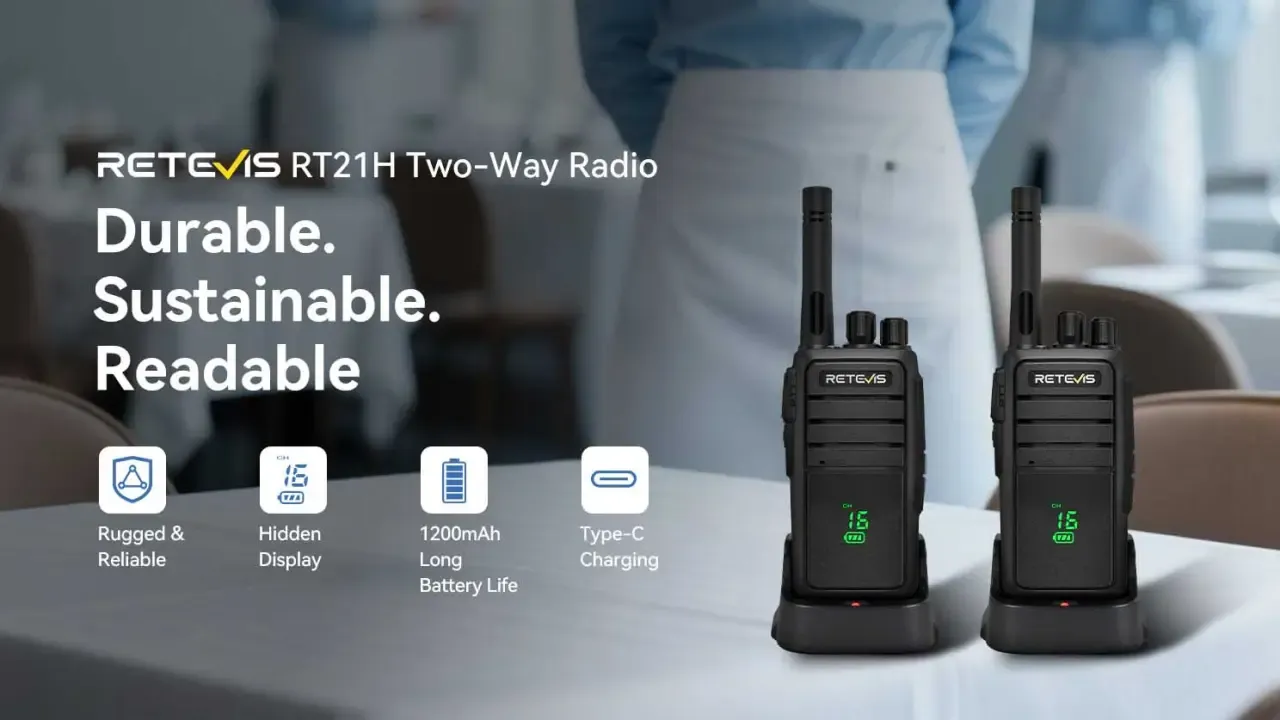
Key specifications include 16 FRS channels with CTCSS/DCS privacy codes, a 1200mAh lithium-ion battery delivering up to 21.5 hours of use and 50 hours on standby, an emergency alarm triggered by a side key, VOX hands-free operation with compatible earpieces, and a low-battery alert with battery-save mode.
The 21.5-hour battery life covers a standard school day plus after-school activities without a midday charge. The emergency alarm gives security and administrative staff a one-touch way to signal for help. The hidden display keeps the front face clean and durable — important for devices that get clipped to belts, dropped in desks, and handed between staff. For teams researching the best license free walkie talkie for school security, this combination of emergency function, all-day battery, and rugged build makes the RT21H a strong candidate.
Retevis offers the RT21H in regional frequency versions, including FRS for North America and PMR446 for Europe, so schools can select the compliant model for their location. For European institutions, the PMR446 school radio version delivers the same feature set on CE-compliant frequencies.
RT68B: Six-Pack Bundle with Gang Charger
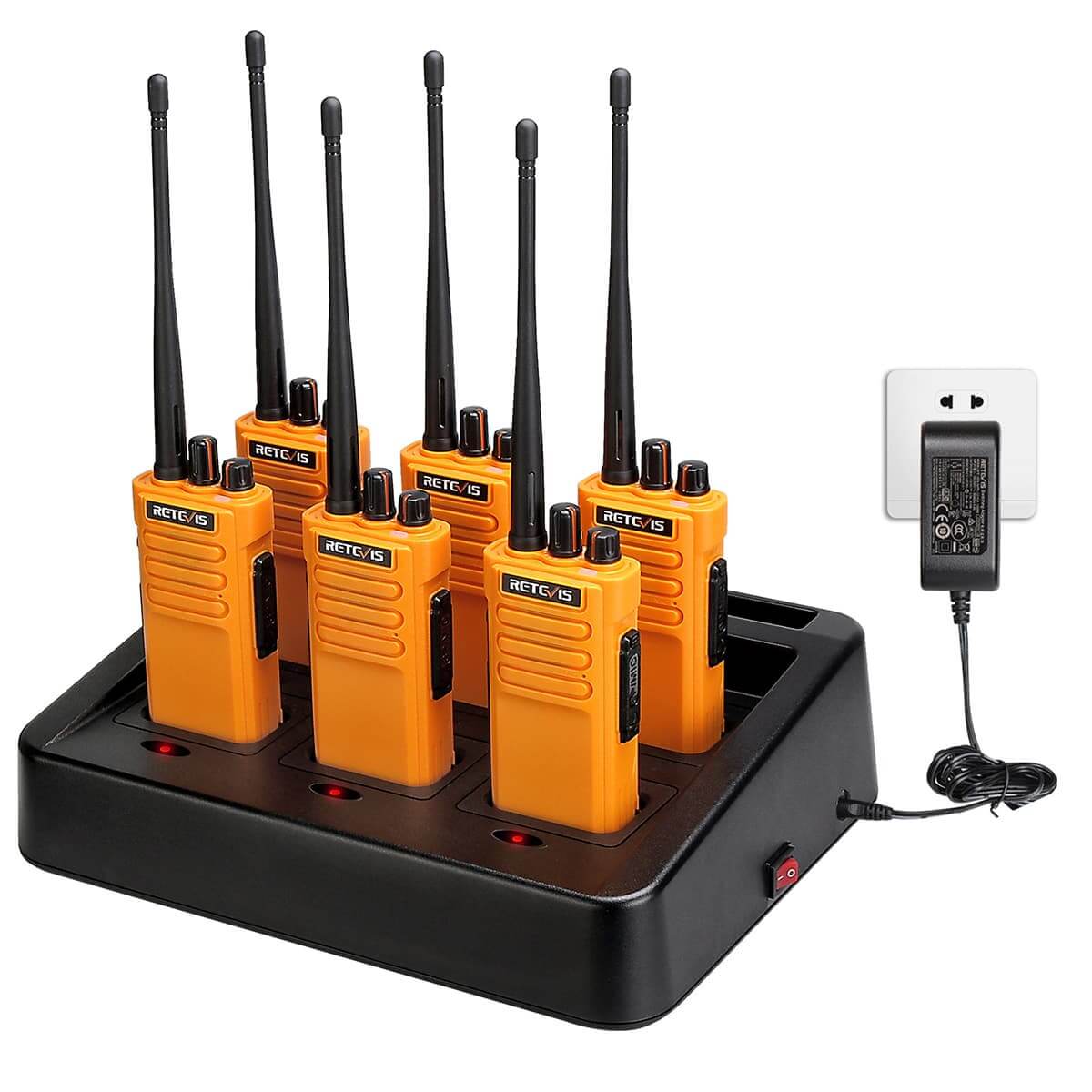
For schools equipping an entire team at once, the Retevis RT68B comes as a six-pack bundle purpose-built for coordinated deployment. The RT68B runs on FRS frequencies and includes 16 channels with a 1200mAh battery rated for approximately 14.5 hours of operation.
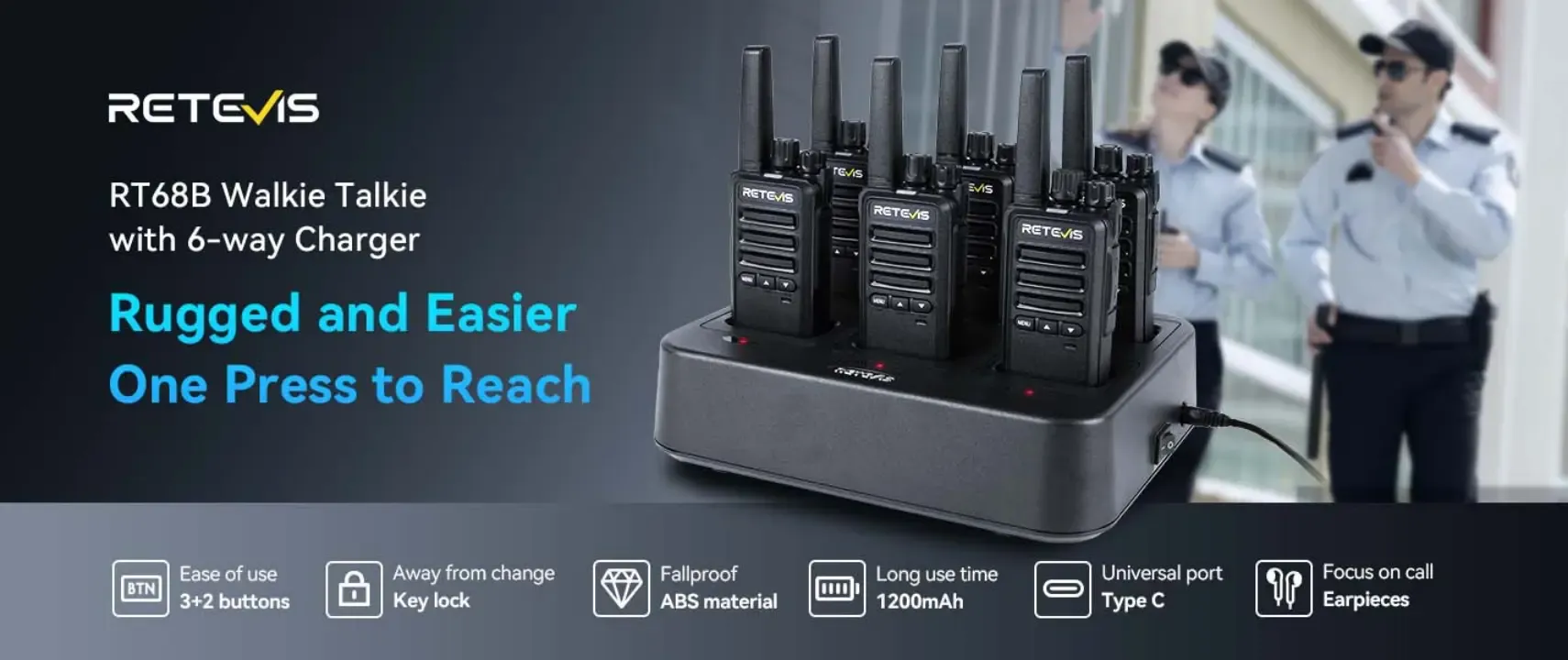
What makes the six-pack practical is not just the count — it is the included accessories. The bundle ships with six radios pre-programmed for out-of-the-box use, six ear-hook earpieces for discreet hands-free communication, a six-way gang charger that powers every unit simultaneously, and belt clips and hand straps for each radio.
The gang charger solves a real operational problem. Instead of tracking six individual chargers and outlets, staff drop all six radios into one station at the end of the day. Every unit charges overnight and is ready for the next morning. This is especially useful during back-to-school season, when schools set up communication systems for the new academic year and need every radio ready on day one. For teams looking for an FRS radio with earpiece and gang charger in one package, the RT68B eliminates the guesswork of buying accessories separately.
The RT68B's ABS body withstands drops and daily wear, and the ear-hook earpieces allow security staff to hear calls clearly in noisy environments like cafeterias and gymnasiums.
Retail, Hotel, and Restaurant: RT22 and B3H
Service teams move constantly. They carry trays, restock shelves, handle luggage, and greet customers. A radio that is too heavy, too bulky, or requires two hands to operate gets left behind. The right radio disappears into the workflow.
RT22: Ultra-Light with Shoulder Mic
The Retevis RT22 weighs 113 grams with battery — lighter than most smartphones — and measures 136 × 56 × 21 mm with the antenna. It clips to a belt, apron, or uniform without pulling or bouncing.
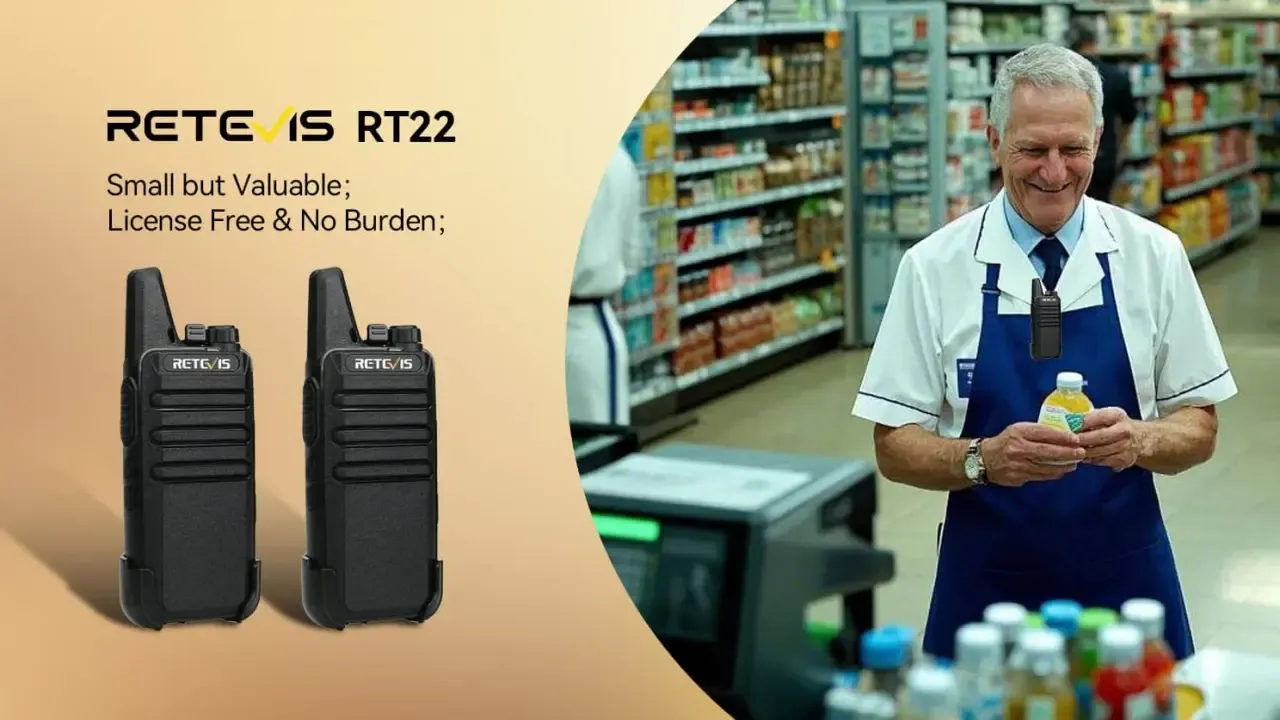
The RT22 ships with a shoulder microphone and supports VOX, or voice-operated transmission. With VOX enabled through the shoulder mic, staff transmit simply by speaking — no button press required. This matters in environments where hands are always occupied. Retail associates carrying boxes or handling transactions stay connected without setting down merchandise. Hotel housekeeping staff pushing carts and changing linens call the front desk without stopping. Restaurant servers balancing plates and managing multiple tables relay orders and requests mid-stride.
Specifications include 16 FRS channels, a 1000mAh lithium-ion battery, Type-C charging, and CTCSS/DCS privacy codes. The shoulder mic keeps the radio clipped at the waist while the microphone sits at collar level, so audio stays clear even in noisy dining rooms or busy sales floors. This makes the RT22 a solid two way radio for retail store communication, a practical hotel two way radio with shoulder mic, and an efficient restaurant communication radio that is license free. For small business owners, the RT22 hits a practical price point while delivering the features frontline teams actually use — a strong option for anyone searching for a walkie talkie for small business no license needed.
B3H: Ultra-Thin for Customer-Facing Roles
The Retevis B3H takes compactness further. At 15mm thick — roughly the width of a finger — it is designed for staff who interact directly with customers and need a radio that stays out of sight.
Key specifications include a 15mm ultra-thin body measuring 148 × 55 × 15 mm with the built-in antenna, a 1620mAh lithium-polymer battery with up to 18 hours continuous use and 49 hours standby, a shatterproof hidden LED display showing channel, battery, and signal status, 16 FRS channels with CTCSS/DCS, Type-C charging, VOX hands-free operation, and an emergency alarm.
The B3H is the third-generation evolution of the RT22 platform, sharing FRS compatibility with other Retevis radios while adding the slim form factor. The shatterproof display resists cracks from drops, and the hidden design keeps the front face smooth and professional. The built-in antenna eliminates protruding parts that can catch on pockets or uniforms.
Front desk agents, concierge staff, boutique retail associates, and fine-dining hosts carry the B3H in a pocket or on a lapel. Customers see a polished staff member, not a bulky device. The 18-hour battery life covers even double shifts, and Type-C charging works with the same cables most businesses already use for phones and tablets. For European markets, Retevis offers the B63H — the same ultra-thin design on PMR446 frequencies.
Radio Buying and Deployment Checklist
Before placing an order, run through this checklist to avoid common mistakes.
- Match the frequency standard to your region. FRS for North America, PMR446 for Europe and the UK. These are not interchangeable — a PMR446 radio will not communicate with an FRS business radio, and using the wrong type may violate local regulations.
- Count simultaneous users, not total staff. A 20-person restaurant may only need six radios on the floor at once. Buy for the busiest shift.
- Match the form factor to the role. Security and facilities staff need rugged, full-size radios. Front desk and sales staff need slim, discreet ones. Mixing models within one team is normal — they all communicate on the same FRS or PMR446 channels.
- Plan charging before deployment. Multi-unit gang chargers save time and counter space for teams of six or more. Smaller teams can use individual Type-C or USB chargers.
- Set channel assignments in advance. Decide which channel each team uses — for example, Channel 1 for floor staff, Channel 2 for management, Channel 3 for emergency. Write it down and train everyone on day one.
- Test coverage on-site. Walk the entire facility — basements, stairwells, walk-in coolers, loading docks — with the radios. Concrete, steel, and refrigeration equipment can block signals. If dead zones exist, consider higher-power models or repeaters.
- Budget for spare earpieces and batteries. Earpieces wear out and get lost. Having two or three spares on hand prevents a missing accessory from taking a radio out of service.
Find the Radio That Right Fit
Retevis license-free radios give small and mid-sized teams instant, reliable communication without the cost and complexity of licensed systems. The right model depends on the environment — rugged and long-lasting for school campuses, light and hands-free for service floors, slim and discreet for customer-facing roles. A Retevis license free radio for small team use scales from a single pair to a full six-pack deployment, all on the same no-license, no-monthly-fee platform.
- Retevis RT21H— Hidden-display FRS/PMR446 radio with 21.5-hour battery and emergency alarm → [https://www.retevis.com/products/retevis-rt21h-license-free-walkie-talkie-with-hidden-display]
- Retevis RT68B— Six-pack FRS bundle with earpieces and six-way gang charger → [https://www.retevis.com/products/retevis-rt68b-frs-two-way-radio-6-pack-with-earpiece-plus-gang-charger]
- Retevis RT22— 113g ultra-light radio with shoulder mic and VOX → [https://www.retevis.com/products/retevis-rt22-lightweight-2-way-radios-for-business-with-mic-and-earpiece-10pack]
- Retevis B3H— 15mm ultra-thin radio with 1620mAh battery and shatterproof display → [https://www.retevis.com/products/b3h-frs-ultra-thin-license-free-walkie-talkie-with-hidden-display]
For help matching radios to a specific facility, contact the Retevis team with your site size, staff count, and primary use cases.





 Google
 Amazon
Comments
No data Yet