
Table of Contents
What Features Buyers Overvalue When Shopping for Construction Walkie Talkies
- Posted by:Retevis
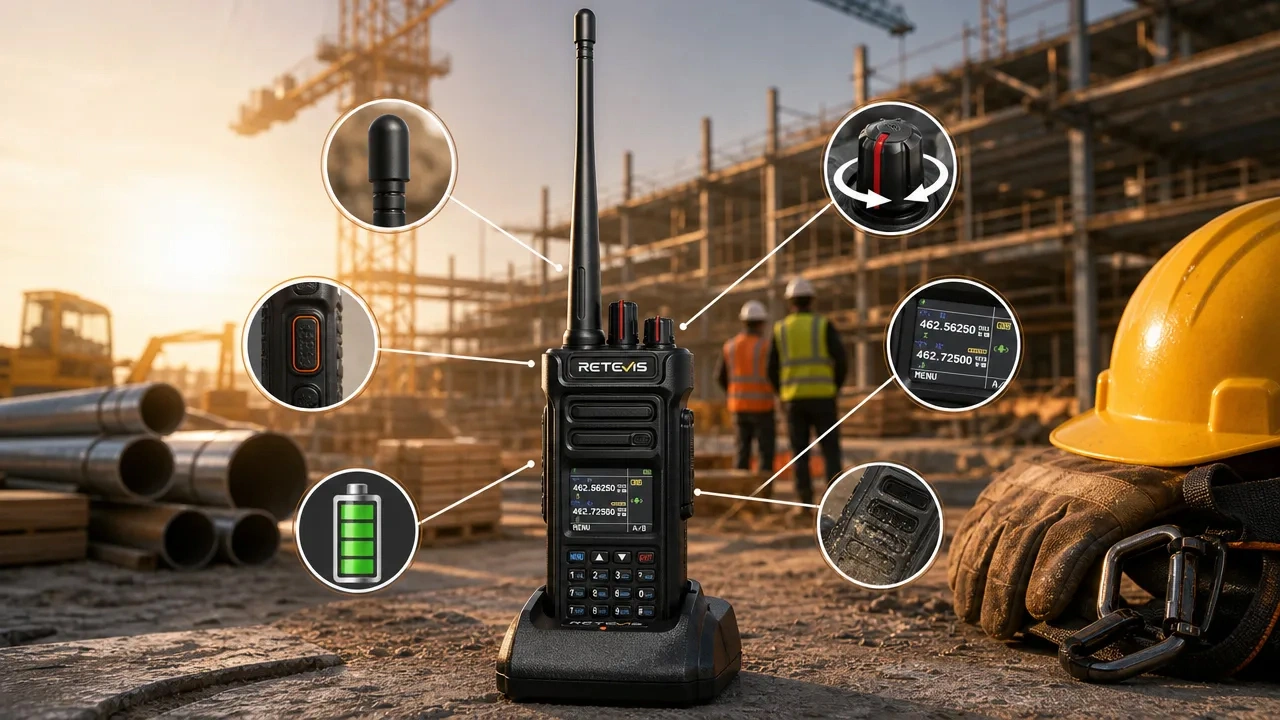
Most buyers evaluate construction walkie talkies by comparing spec sheets. Channel count, frequency range, transmit power—numbers that look definitive but often mislead. A radio with impressive figures on paper can fail within a month on an active job site. The problem is not the specifications themselves. It is the gap between laboratory measurements and field conditions.
The following sections examine what buyers typically overvalue, what they undervalue, and what they ignore entirely.
What Construction Buyers Overvalue in Heavy-Duty Walkie Talkies
Channel Count: More Is Not Better
A thirty-two-channel radio sounds more capable than a sixteen-channel model. On a construction site, this is rarely true.
Most projects need three to five channels at most: one for general operations, one for crane or heavy equipment, one for security or supervisors. Additional channels increase menu complexity and the probability that a worker switches to the wrong channel and misses a critical call.
The practical limit is determined by team size and role separation, not by the number printed on the box. A worker wearing gloves and operating in noise cannot navigate nested menus quickly. Simplicity in channel structure reduces operator error more than excess capacity.
Dual-Band Coverage: Frequency Range You Will Not Use
UHF and VHF dual-band capability appears on many specification sheets as a premium feature. For construction work, UHF is the standard choice because its shorter wavelengths penetrate steel and concrete more effectively than VHF. VHF performs better in open terrain with minimal obstructions—conditions that describe a farm or a highway, not a building under construction.
A dual-band radio costs more, consumes more power, and adds antenna complexity without delivering practical benefit on most job sites. The feature is not harmful, but it is often irrelevant. Buyers pay for capability they will not activate.
Digital Features: Complexity Without Context
Text messaging, GPS tracking, and Bluetooth pairing appear on modern radios as value-added functions. These features assume three conditions that are rarely present on a construction site: clean hands for touchscreen operation, quiet environments for reading text, and time for non-urgent communication.
A worker in a harness thirty feet above ground cannot type a message. A foreman directing concrete placement cannot pause to read a GPS coordinate. In practice, these functions add cost, battery drain, and potential software failure points without improving daily communication. Voice remains the only medium that functions under construction conditions.
What Actually Determines Survival of Heavy Duty Walkie Talkies
Audio Output Power: The Hidden Threshold
Spec sheets emphasize transmit power in watts. They rarely highlight audio output power—the wattage of the speaker that delivers received voice to the ear. This is the critical number for noisy environments.
OSHA standard 29 CFR 1926.52 sets a permissible exposure limit of 90 dBA over an eight-hour shift, but actual construction noise frequently exceeds 100 to 115 dBA from equipment such as concrete saws, pile drivers, and steel cutting. At these levels, a speaker rated below 2 watts is inaudible beyond arm's length. The message arrives, but the recipient cannot hear it.
High-output audio—3W or more—combined with noise-suppression circuitry, is the difference between a radio that technically functions and one that practically communicates. This specification is more important than channel count, frequency range, or digital features combined.
Battery Contact Reliability: The Slow Failure
Battery life is measured in hours of continuous transmission. This is a laboratory metric. The field metric is different: how many months before the battery contacts degrade and the radio begins to power off randomly.
Construction sites generate concrete dust, metal particles, and chemical residue. These contaminants enter the battery compartment through normal handling. Over three to six months, they accumulate on the contacts and create intermittent resistance. The radio shows full charge, then dies mid-transmission. The user blames the battery. The actual failure is the contact interface.
A well-designed battery compartment uses sealed contacts, gold-plated surfaces, or spring-loaded designs that maintain pressure despite dust intrusion. These details do not appear on spec sheets but determine whether the radio survives its first year.
PTT Button Tactile Feedback: The Emergency Variable
Push-to-talk buttons vary in actuation force, travel distance, and feedback type. A light-touch button with minimal travel is easy to press accidentally. A button with excessive resistance requires deliberate pressure that slows transmission initiation.
In an emergency, a worker may be wearing thick gloves, operating in rain, or reaching for the radio without looking. The button must provide clear tactile confirmation—enough travel to prevent accidental activation, enough resistance to prevent false triggers, and an audible or tactile click that confirms transmission has begun.
This is not a measurable specification. It is a design decision that separates radios built for offices from radios built for construction. The only valid test is to operate the button with wet work gloves in a noisy environment and verify that transmission begins when intended and only when intended.
The Conditions That Kill Construction Walkie Talkies Slowly
Temperature Cycling: The Invisible Stress
Construction radios experience temperature swings that consumer devices never encounter. Summer sun heats exposed units to 60°C. Winter mornings drop them below freezing. This cycling causes thermal expansion and contraction in solder joints, LCD displays, and plastic housings.
LCD liquid crystals slow at low temperatures, making displays unreadable. Battery capacity drops by 30% or more in cold conditions. Plastic housings become brittle and crack on impact after repeated thermal stress. A radio that passes a single temperature test may fail after three months of daily cycling.
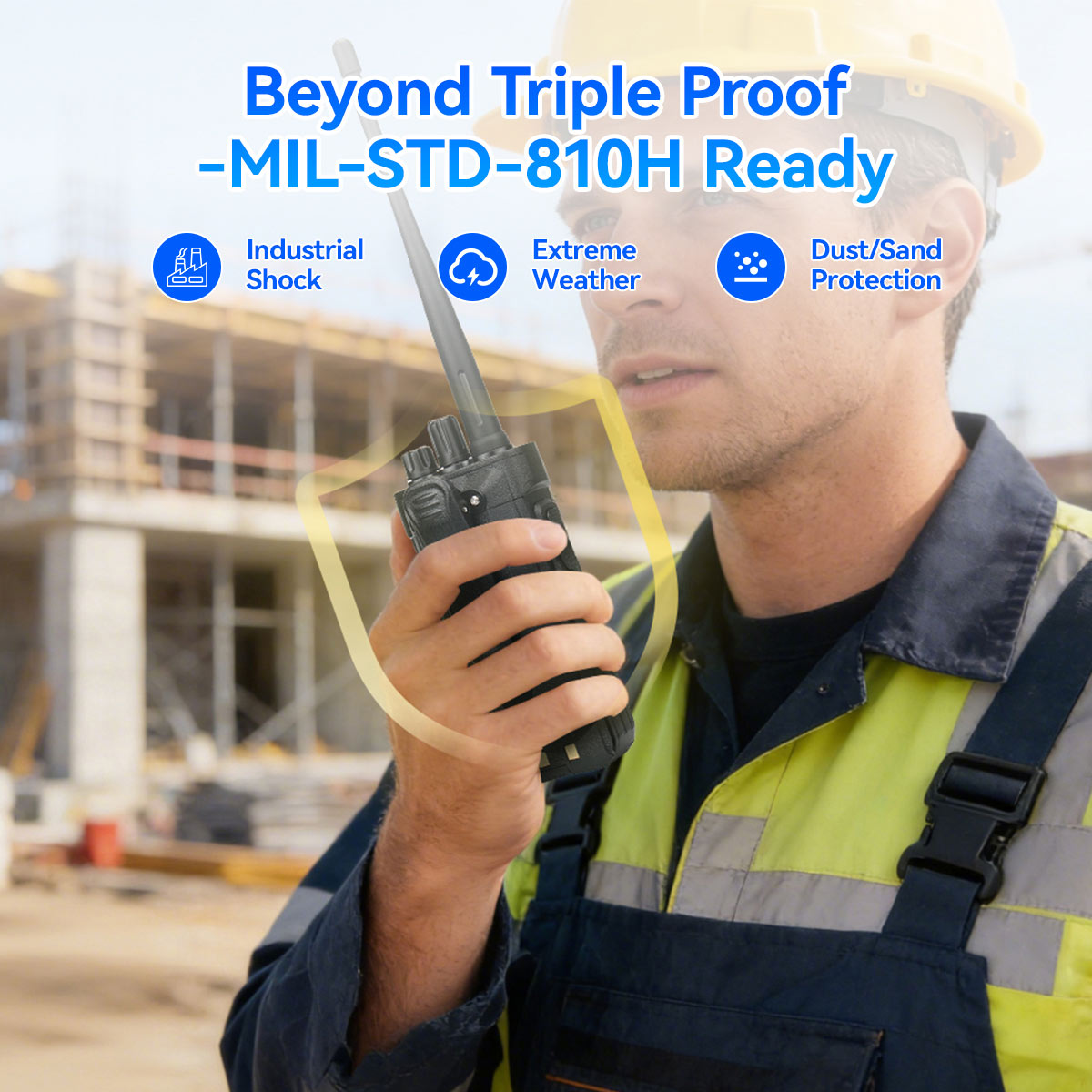
MIL-STD-810 temperature shock testing subjects devices to rapid transitions between extremes. This is a better predictor of field survival than steady-state temperature ratings. Buyers should ask for thermal cycling data, not just operating temperature ranges.
Chemical Exposure: Beyond Water and Dust
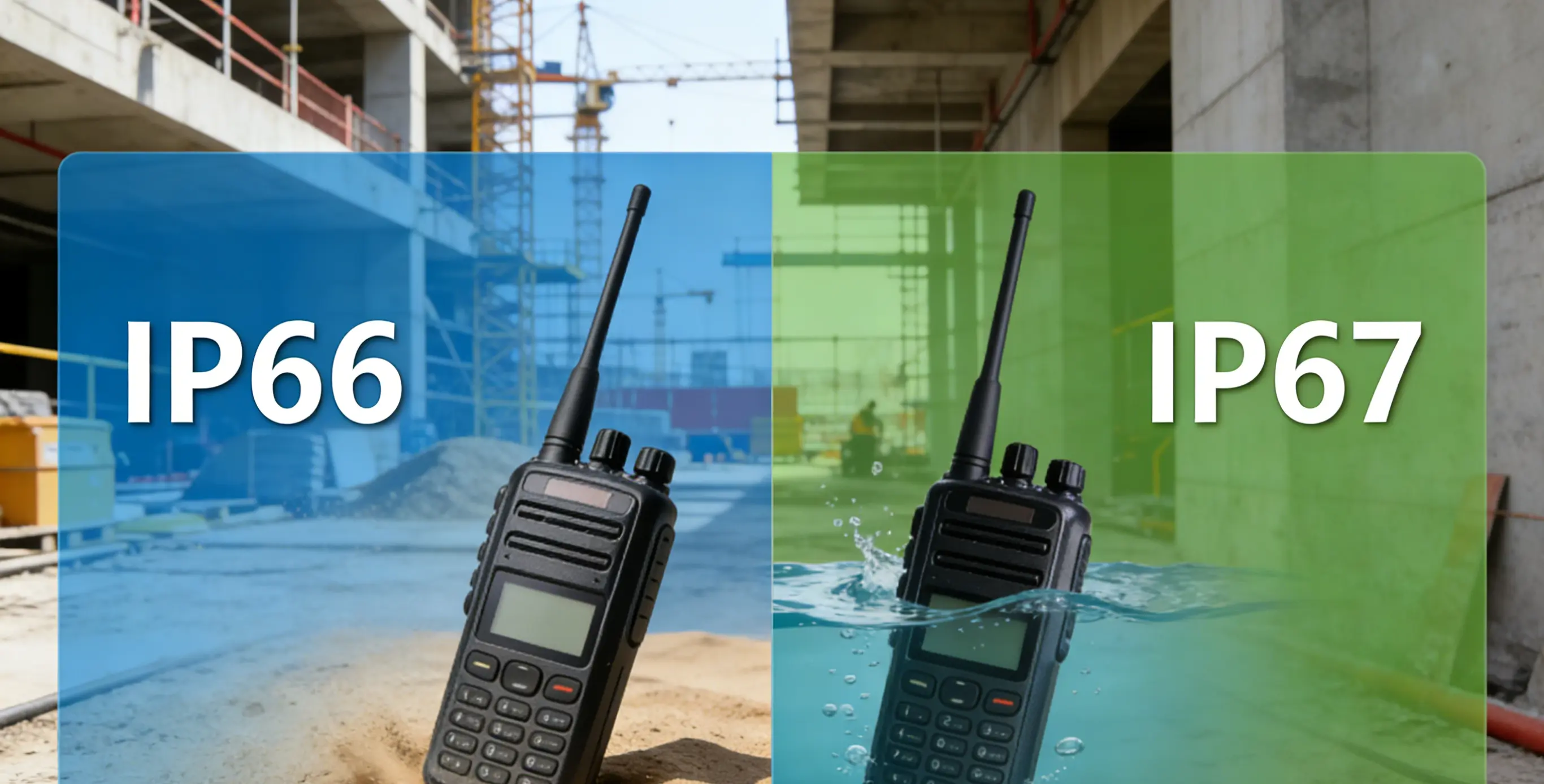
IP ratings measure resistance to water and solid particle ingress. They do not measure resistance to alkaline concrete dust, hydraulic fluid, or form-release oil. These chemicals degrade rubber seals, corrode metal contacts, and dissolve protective coatings over time.
A radio with IP67 certification can survive submersion in clean water. The same radio exposed to concrete slurry may experience seal degradation within twelve to eighteen months. The IP rating is valid but incomplete. Chemical compatibility data—rarely published—is necessary for accurate life prediction.
Charging Practices: The User-Induced Failure
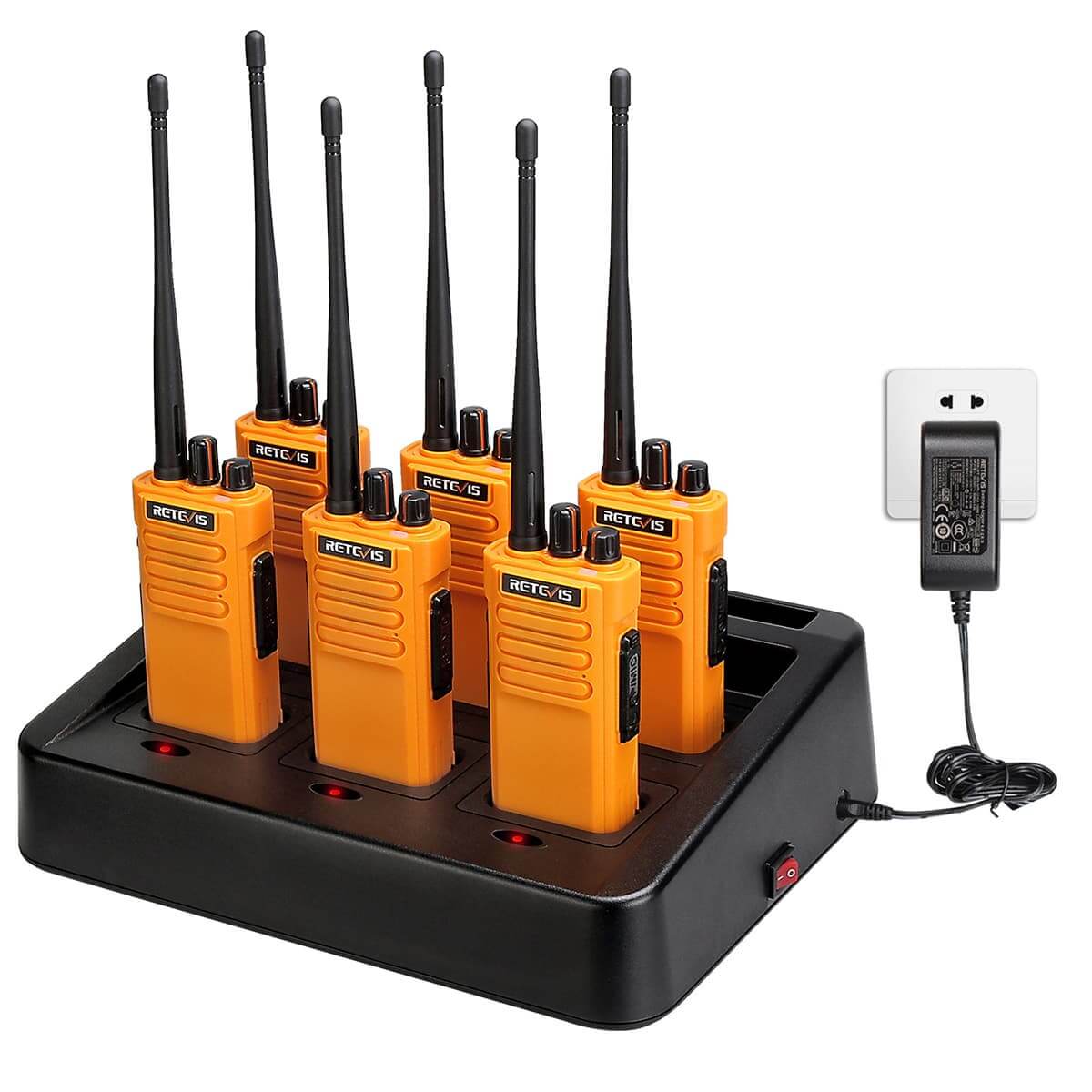
Mixed battery ages, third-party chargers, and inconsistent charging cycles create problems that manufacturers do not warranty. Lithium-ion battery management chips require calibration to the specific cell chemistry and charger profile. A generic charger may deliver correct voltage but wrong current curve, causing the fuel gauge to drift.
The result is a battery that reads 80% charge but delivers only 30% capacity, or a radio that shuts down unexpectedly despite showing two bars. This is not a radio failure. It is a system failure caused by mismatched charging infrastructure. Standardized charging stations and battery rotation programs prevent this more effectively than higher-capacity cells.
A Better Way to Evaluate Two-way Radio for Construction
Test for Penetration, Not Distance
Manufacturers specify maximum range in open terrain. Construction sites are not open terrain. The relevant test is signal penetration through concrete, steel, and earth. A radio rated for five kilometers in open air may fail between two floors of a parking garage.
Request a site-specific demonstration. Place one radio in the basement and one on the roof. Verify communication without line of sight. The distance specification is irrelevant if the signal cannot penetrate the materials between transmitter and receiver.
Test for Audibility, Not Wattage
Audio output power in watts does not directly translate to intelligibility in noise. Speaker design, enclosure acoustics, and noise-suppression algorithms determine whether a voice is understood at 100 dBA.
Conduct a field test. Place the radio three meters from the listener in active construction noise. Transmit standard safety phrases. If the listener cannot repeat the message accurately without asking for repetition, the audio system fails regardless of its wattage rating.
Test for Blind Operation, Not Menu Navigation
A radio with comprehensive menu options and programmable features requires visual attention to operate. On a construction site, visual attention belongs on the work, not on the device.
Test every critical function—channel change, volume adjustment, emergency alert—with eyes closed and gloved hands. If the operation requires looking at the screen, the radio is not built for field conditions. The best interface is one that can be operated by touch alone, under stress, without visual confirmation.
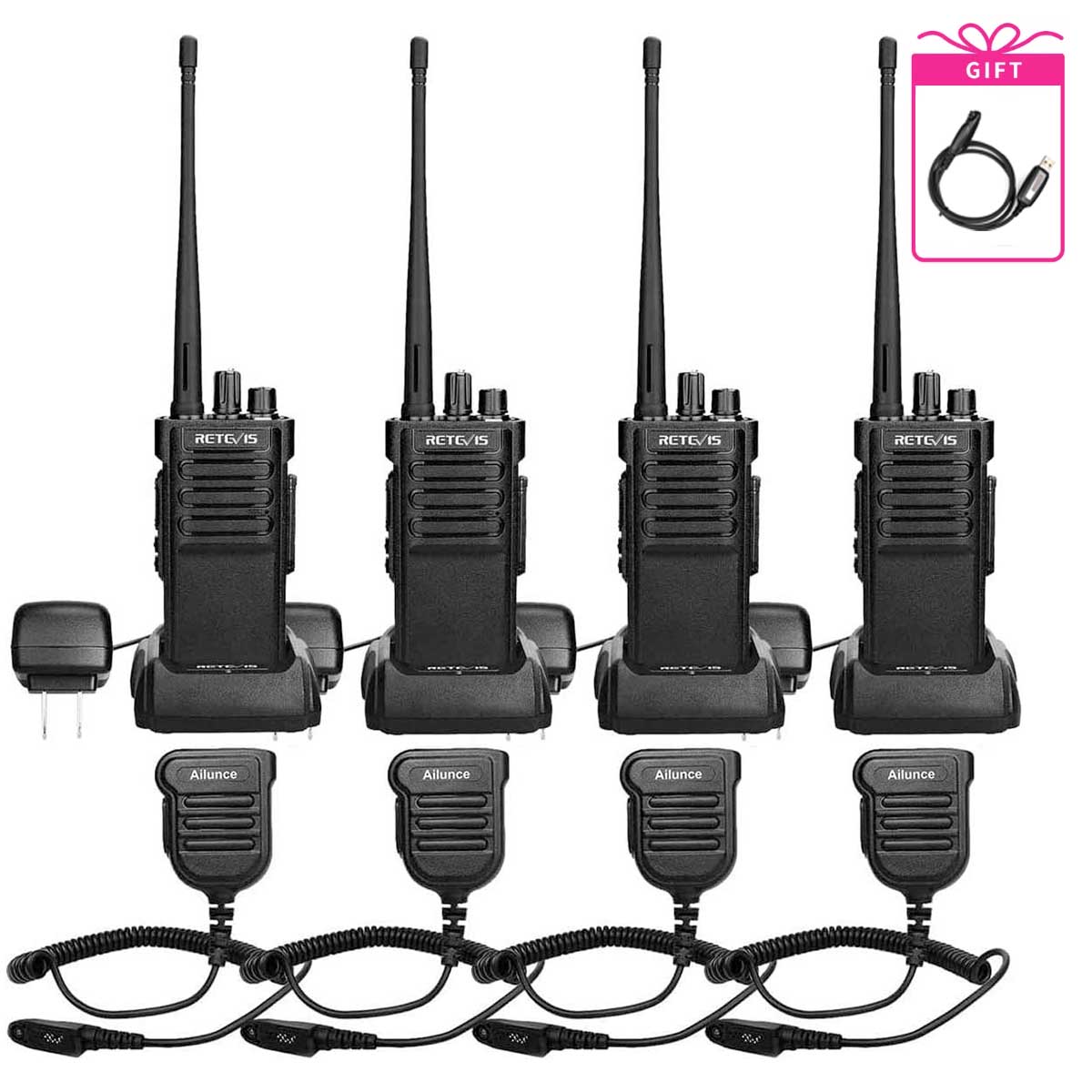
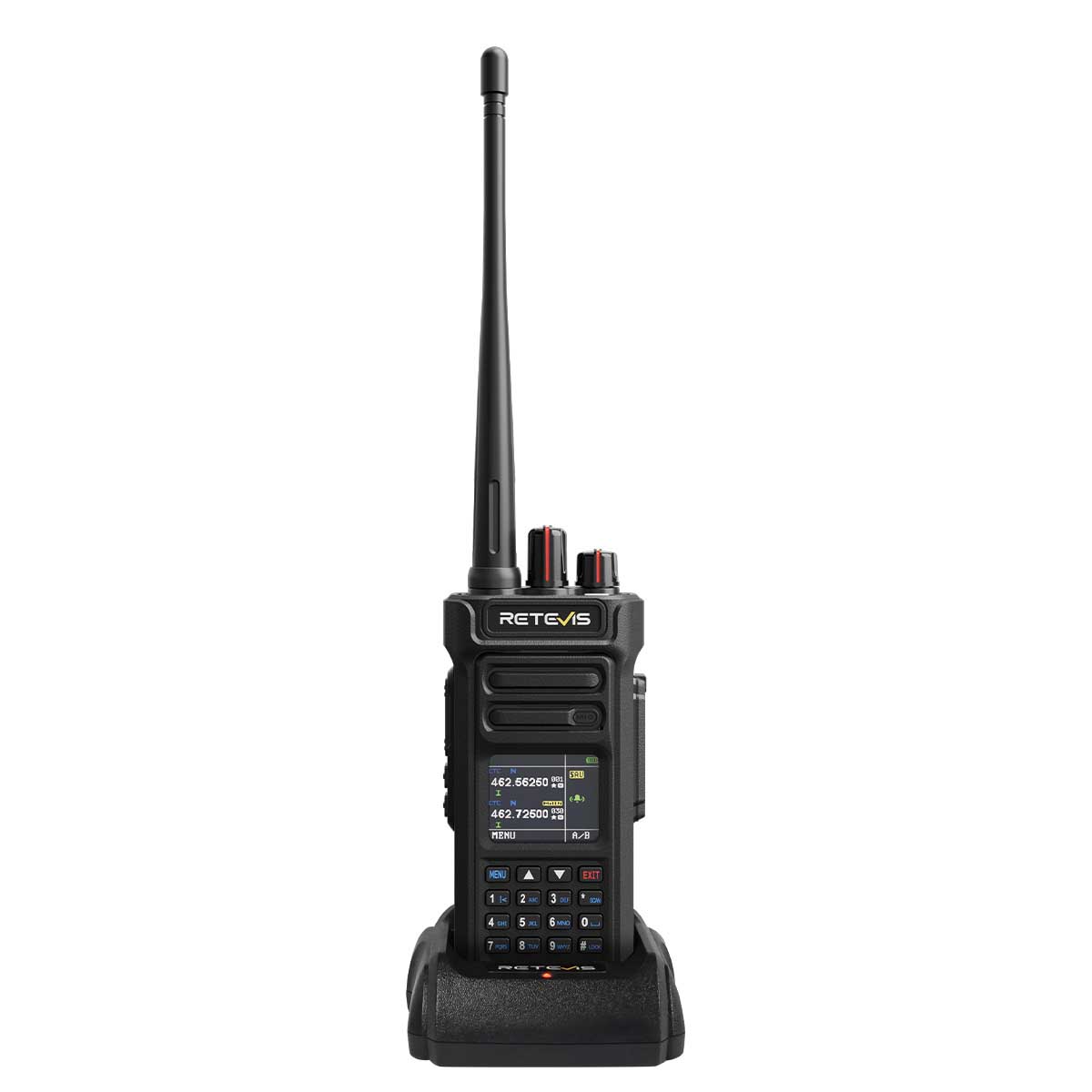
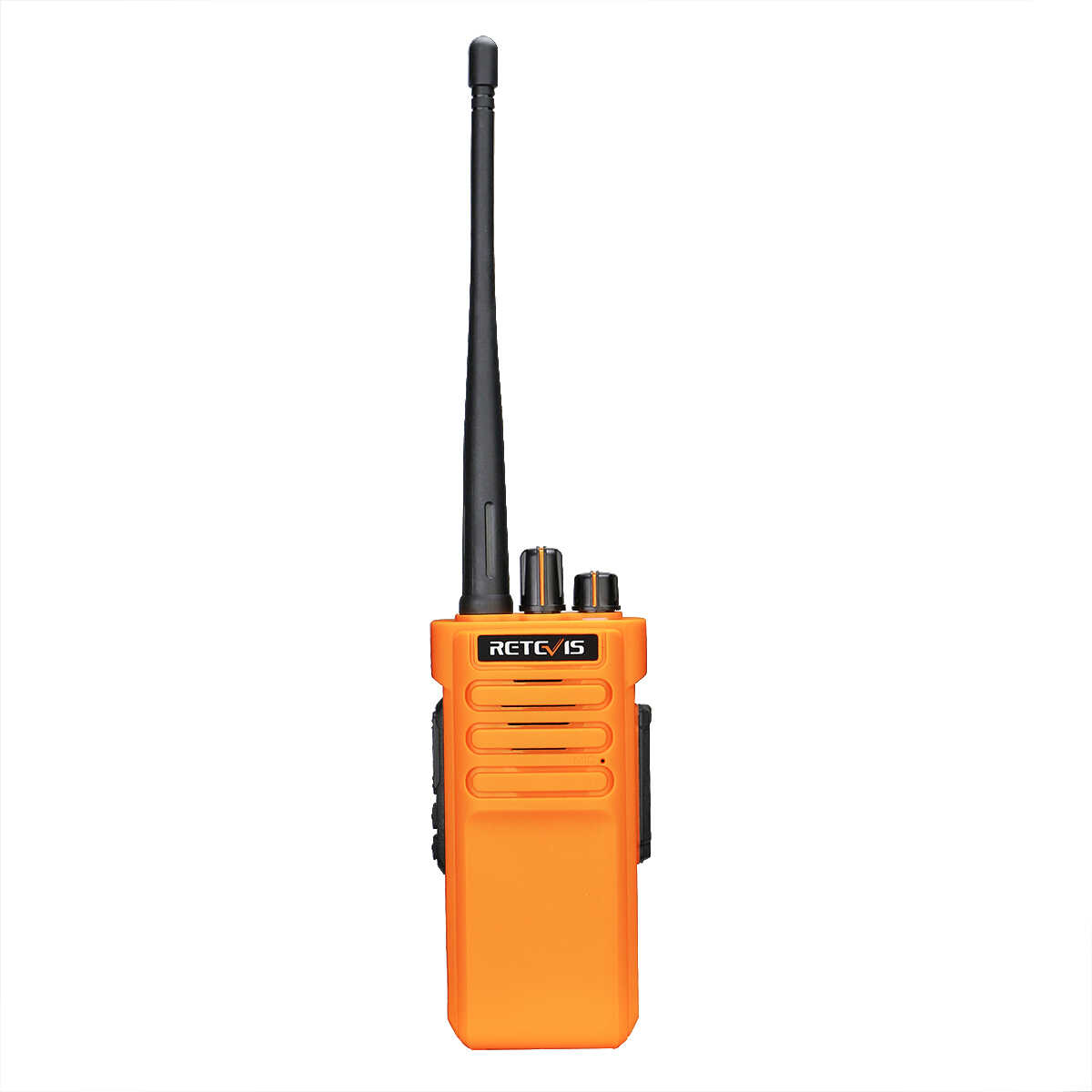
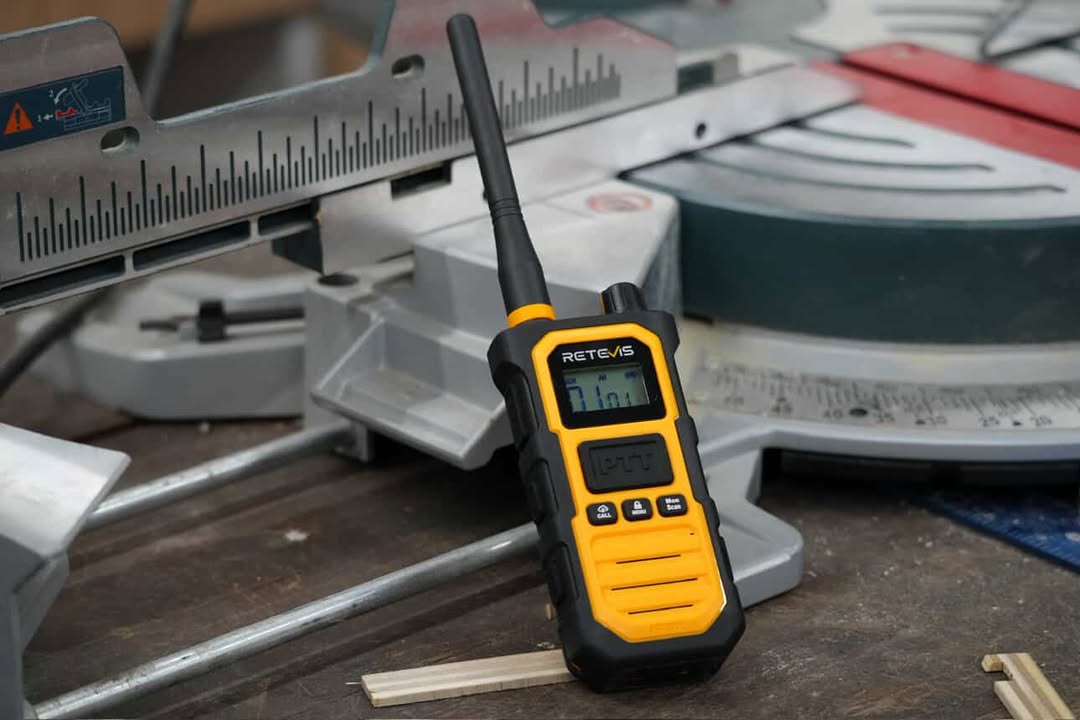
Where the RT29S Construction Walkie Talkie Fits
The RT29S design reflects the priorities outlined above. It does not maximize channel count, frequency range, or digital features. It maximizes the functions that determine whether a radio survives daily use on a construction site.
Audio output is rated for clarity above 100 dBA, with speaker and circuitry selected for intelligibility rather than specification impressiveness. The battery compartment uses sealed contacts with a dust-resistant design. The PTT button provides distinct tactile feedback with travel distance calibrated for gloved operation.
These are not headline features. They are the details that determine whether a two-way radio for construction functions on day three hundred as reliably as on day three.
View the RT29S specifications and see how it helps construction teams maintain clear and reliable communication across challenging job site conditions.
Conclusion
Choosing the right construction radio is not about finding the cheapest option. It is about finding the option that delivers the best combination of durability, performance, features, and value. The right radio system will pay for itself in reduced rework, improved safety, and higher productivity. The wrong one will cost you money every single day.
Reference
U.S. Department of Labor, Occupational Safety and Health Administration. (n.d.). Noise in Construction. 29 CFR 1926.52. https://www.osha.gov/noise/construction




 Google
 Amazon
Comments
No data Yet