
Table of Contents
How to Work the ISS With Ham Radio: From SSTV to Your First Contact
- Posted by:Retevis
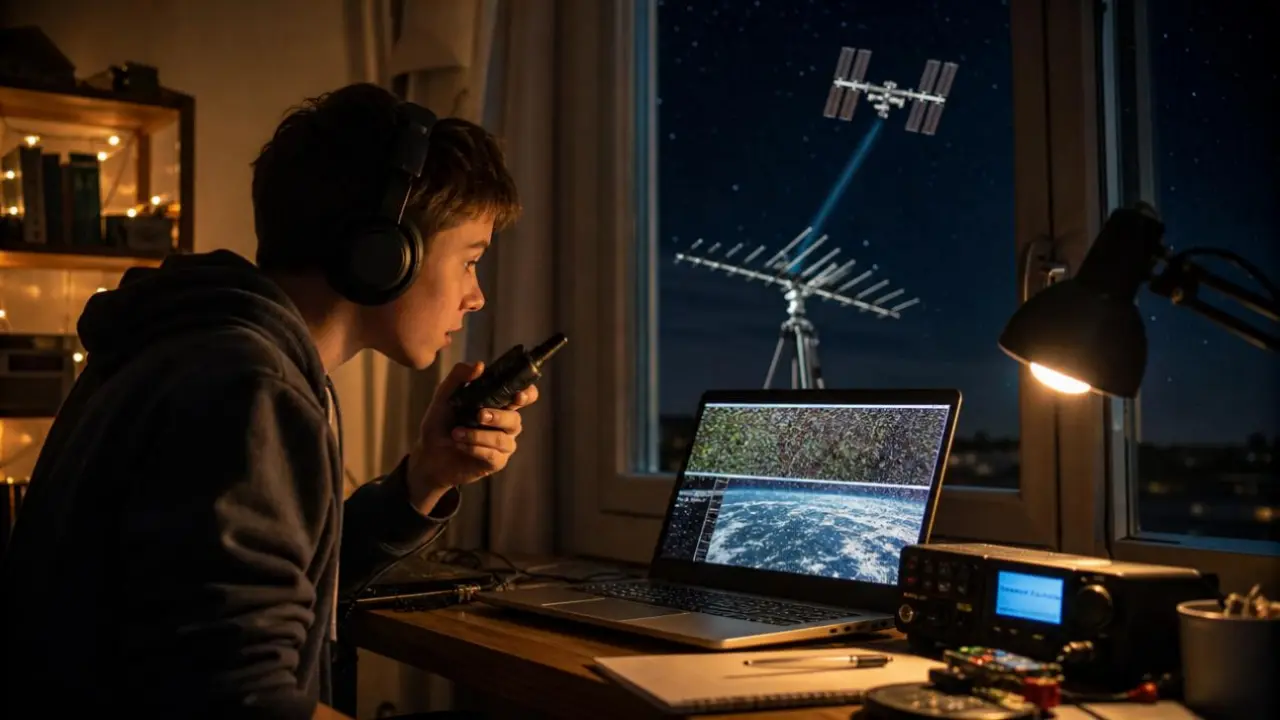
Many ham operators start with one clear question: can you talk to the ISS with a ham radio? The short answer is yes. The International Space Station carries fully operational amateur radio equipment as part of the ARISS program, and it supports multiple ways for ground-based hams to take part. Some activities require no license at all. Others let licensed operators talk to other hams across thousands of miles through the station’s onboard repeater.
This guide covers every practical entry point, from low-effort SSTV reception to completing your first official ISS contact. It includes 2026 active frequencies, standard operating rules, and common mistakes that trip up first-time users.
ISS SSTV: The Easiest Entry Point
Slow-scan television, or SSTV, is the most accessible way to join ISS ham radio activity. The ARISS team runs regular SSTV events, where the station transmits photos captured from space on a standard ham frequency. Anyone with a basic receiver can pick up the signal and decode the images on a phone or computer. No ham license is required, because this activity only involves listening, not transmitting.
Most ARISS SSTV signals broadcast on 145.800 MHz FM, the same frequency used for direct crew voice downlink. Most events use the PD120 SSTV mode. Some Russian-led events use a separate UHF frequency and different mode, but 145.800 MHz remains the standard for most global events.
Event schedules are posted in advance on the official ARISS website. Searches for “ISS ham radio schedule today” will pull up upcoming passes and active event windows for any location.
Receiving SSTV requires a receiver capable of tuning to 145.800 MHz FM, and a simple antenna. A basic dual-band handheld radio or dedicated wideband receiver works well for this task. Run SSTV decoding software on a phone or laptop, and place the device near the speaker during an ISS pass. Successful image decodes qualify for an official ARISS SSTV award certificate, available to both licensed operators and shortwave listeners.
What You Can Actually Do With Ham Radio on ISS
Two main types of voice activity take place on the ISS. Many new operators misunderstand how the system works.
Direct contact with astronauts happens only during scheduled events. These are almost always arranged for schools and educational groups through the ARISS program. Random casual calls to crew members are extremely unlikely to receive a reply. This is not the day-to-day way most hams work the ISS. Direct voice contacts use 145.800 MHz as the downlink, with region-specific uplink frequencies.
Cross-band repeater contacts are the main activity for regular hams. The ISS carries a V/U cross-band repeater. It receives signals from the ground on the 2 meter band, and retransmits them on the 70 centimeter band. When a signal goes into the repeater, hams across thousands of miles can hear it clearly. This is how most operators make their first ISS contact. The repeater runs most of the time, but may be turned off during educational events, spacewalks, or docking maneuvers.
Expensive satellite equipment is not required to get started. A 5-watt dual-band handheld radio and a simple whip antenna can receive the downlink clearly during high-elevation passes. With a clear view of the sky and a pass above 70 degrees elevation, many operators complete successful contacts with basic handheld gear. Directional antennas deliver more reliable results, but they are not required to try.
Current ISS Ham Radio Frequencies (2026)
These are the standard active frequencies for amateur radio on the ISS. Always check for temporary operational changes before a planned pass.
- Direct voice & SSTV downlink: 145.800 MHz FM (worldwide)
- Cross-band repeater uplink: 145.990 MHz FM (67 Hz PL tone required)
- Cross-band repeater downlink: 437.800 MHz FM
- APRS packet uplink & downlink: 145.825 MHz (worldwide)
The ISS orbits at high speed, so the received signal shifts slightly in frequency during a pass. This effect is called Doppler shift. For FM voice operation, small manual adjustments to the downlink frequency work well for most operators. At the start of a pass, the signal sits slightly above the listed frequency. At the end of a pass, it sits slightly below. Fine-tune by ear as you listen.
How to Contact ISS With Ham Radio: Step by Step
Follow this process for consistent results on a first attempt, using the cross-band repeater.
1.Locate your next high pass
Use a tracking tool such as Heavens-Above or a mobile ISS tracker app. Prioritize passes with maximum elevation above 60 degrees. Higher elevation means a stronger signal and more operating time. Record the exact start, peak, and end times in UTC. All ham radio schedules use UTC, not local time.
2.Pre-program your frequencies
Set the repeater downlink frequency into your radio first. Tune in a few minutes before the pass starts, and listen for the repeater beacon or other on-air operators. Adjust for Doppler shift as the signal comes into range. Program the uplink frequency with the correct 67 Hz PL tone before transmitting.
3.Listen before transmitting
Spend the first half of the pass just listening. Get familiar with how the signal sounds, and observe how other operators call through the repeater.
4.Use short, clear call signs
When ready to call, keep transmissions short. Say the call sign clearly, followed by “via ISS”. Repeat once if needed. Never hold the transmit button continuously, and never call over other operators.
5.Confirm the contact
If another operator responds, exchange call signs and a basic signal report. This counts as a complete contact. Log all contact details in UTC for official records.
Successful ISS contacts qualify for special awards and official QSL cards. Operators can request an ARISS QSL card to confirm the contact, following standard bureau or direct mail procedures.
Common Mistakes That Ruin First Attempts
Most first-time failures stem from simple, avoidable errors.
1. Using local time instead of UTC. Tracking tools show pass times in UTC by default. Incorrect time conversion is the top reason operators miss passes entirely.
2. Attempting low-elevation passes. Trying to work the ISS on a low pass wastes time and battery life. Wait for high overhead passes for the best chance of success.
3. Transmitting nonstop. Holding the PTT button for long periods blocks the repeater for everyone else. Short, spaced calls produce far better results.
4. Forgetting the PL tone on the uplink. The repeater will not respond to signals without the correct 67 Hz subaudible tone. Many new operators program the frequency but skip the tone setting.
5. Ignoring event schedules. During active SSTV events, the voice repeater may be switched to support the image transmission. Check the current schedule before planning a voice contact attempt.
ISS ham radio gives ordinary operators a chance to interact with hardware orbiting 250 miles above the planet. It does not require a top-tier station or years of operating experience.
Operators without a license can wait for the next SSTV event and try receiving an image from space. Licensed operators can start by listening to a few passes before attempting to transmit. Every successful reception or contact builds skills for more advanced satellite operating.
73!





 Google
 Amazon
Comments
No data Yet