
Table of Contents
Ham Radio Codes: 10-Codes & Phonetic Alphabet (Complete Guide)
- Posted by:Retevis
Below is a clear breakdown of 10-codes and the standard phonetic alphabet widely used by amateur radio (HAM) operators, plus common radio shorthand. All content is tailored for your blog & HAM audience.
Do Amateur Radio Operators Use 10-Codes?
Short Answer: Yes, but usage varies by region, activity and community.
10-codes were originally created for two-way radio to shorten transmissions, reduce repetition and clarify speech over weak/noisy signals.
US & North America: Still commonly used in local nets, field operations, emergency communications and casual on-air chats. Many veteran HAMs and emergency radio groups rely on them daily.
International DX / Global HAM Community: Less universal. Most overseas operators prefer plain language or standard Q-codes instead of 10-codes to avoid confusion across language barriers.
Formal FCC Operations: The FCC does not mandate 10-codes. You only need to follow official call sign identification rules; 10-codes are a community convention, not a legal requirement.
Common HAM Radio 10-Codes (Most Frequently Used)
These are the most popular 10-codes for amateur radio daily use:
|
Code |
Meaning |
|
10-0 |
Use caution |
|
10-1 |
Poor signal / Weak signal |
|
10-2 |
Good signal / Clear reception |
|
10-3 |
Stop transmitting / End of transmission |
|
10-4 |
Message received / Roger / Okay |
|
10-5 |
Relay message / Pass along info |
|
10-6 |
Busy / Stand by |
|
10-7 |
Out of service / Leaving air |
|
10-8 |
In service / Back on air |
|
10-9 |
Repeat message / Please retransmit |
|
10-10 |
Transmission complete / Standing by |
|
10-13 |
Weather & road conditions |
|
10-19 |
Return to base / No further message |
|
10-20 |
Location / Where are you? |
|
10-21 |
Call you on phone / Contact off-air |
|
10-22 |
Disregard last message |
|
10-33 |
Emergency traffic / Emergency |
|
10-42 |
Traffic / Net ended |
Note: Avoid overusing obscure 10-codes during international QSOs to prevent misunderstanding.
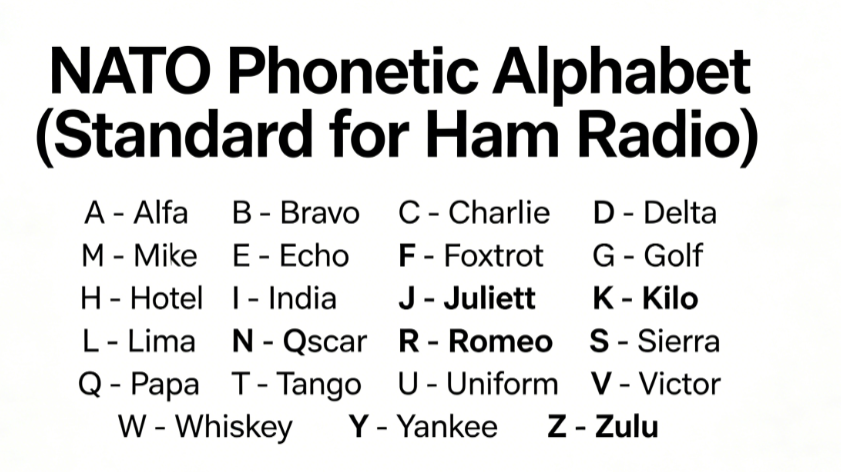
Ham Radio Phonetic Alphabet (NATO Standard Alphabet Code)
Also known as ham alphabet code, this is mandatory for clear call sign pronunciation — especially for weak signals, long-distance DX contacts and noisy bands. It is the most universal code across all amateur radio worldwide.
Full standard phonetic alphabet:
A = Alfa
B = Bravo
C = Charlie
D = Delta
E = Echo
F = Foxtrot
G = Golf
H = Hotel
I = India
J = Juliett
K = Kilo
L = Lima
M = Mike
N = November
O = Oscar
P = Papa
Q = Quebec
R = Romeo
S = Sierra
T = Tango
U = Uniform
V = Victor
W = Whiskey
X = Xray
Y = Yankee
Z = Zulu
Usage Tip:
Always spell your ham call sign using this alphabet when signals are unstable. It eliminates mishearing letters and complies with good on-air etiquette.
Bonus: Classic Ham Q-Codes (Widely Used Worldwide)
Besides 10-codes and phonetic alphabet, Q-codes are the global standard for international HAM communication (far more common than 10-codes for DX):
QTH: My location / Where is your location?
QRX: Standing by / Will listen for you
QSY: Change frequency
QSL: Confirm receipt / Confirm contact
QSO: Radio contact / Conversation
QRP: Low power operation
QRM: Interference / Noise
QRN: Static / Atmospheric noise
Final Summary
To wrap up this guide, let’s recap the key takeaways for every amateur radio operator:
10-Codes: A staple for North American local radio nets and emergency communications, yet not ideal for cross-border QSOs due to regional differences.
Phonetic Alphabet: A must-know universal tool. Mastering it ensures accurate call sign delivery and follows basic on-air etiquette in all operating scenarios.
Q-Codes: The most recognized shorthand across the global HAM community, making them the top pick for international DX contacts.
Learning these essential codes will streamline your communications, reduce errors, help you operate ham radios properly, and ensure smoother communications with fellow operators around the world.








Comments
No data Yet