

Table of Contents
LoRa vs LoRaWAN – Key Differences Explained
- Posted by:Retevis
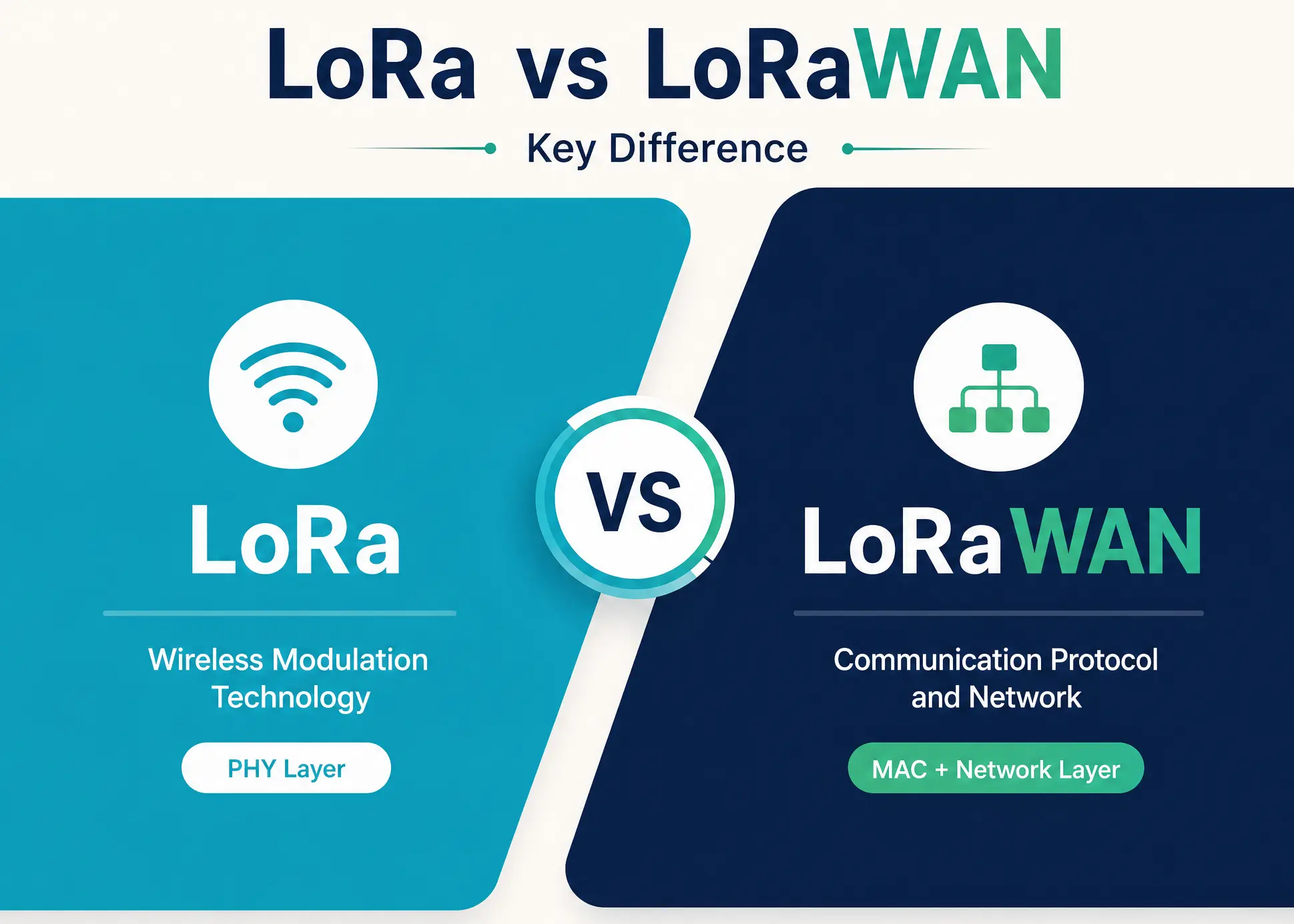
LoRa (Long Range) is the physical layer (PHY) of the communication system. It defines how radio waves are modulated to achieve long-distance, low-power communication. LoRa uses chirp spread spectrum (CSS) modulation, which allows signals to be transmitted over about 10 kilometers, typical environments ruch penetrate buildings, and maintain reliable connectivity even in noisy environments.
LoRaWAN (Long Range Wide Area Network) builds on LoRa by defining the network layer and communication protocols. It enables devices to connect to gateways, which then route data to a network server. LoRaWAN supports large-scale IoT deployments, secure communication, and bidirectional data transfer.
Side-by-Side Comparison LoRa vs LoRaWAN
| Feature | LoRa | LoRaWAN |
|---|---|---|
| Layer | Physical layer (modulation) | Network layer and protocol |
| Communication | Point-to-point | Point-to-multipoint via gateways |
| Data Type | Raw sensor or telemetry data | Structured, secure, and scalable data |
| Network Scalability | Limited | High, supports thousands of devices |
| Power Consumption | Very low | Low, adjustable with device classes |
| Security | None inherently | AES-128 encryption for secure communication |
| Use Case | Simple long-range links | Large-scale IoT, smart city, industrial monitoring |
Technical Features of LoRa and LoRaWAN
- Low Power Consumption: LoRa devices can operate for years on a single battery, reducing maintenance and operational costs.
- Long-Range Transmission: Radio signals can transmit over tens of kilometers, even in urban environments with obstacles.
- Two-Way Communication: Supports both uplink and downlink messages, enabling remote device control and data collection.
- Adaptive Data Rate & Frequency Hopping: LoRaWAN dynamically adjusts data rates and frequency channels to optimize network performance.
- Secure Communication: Uses AES-128 encryption for robust security, protecting sensitive data from interception.
- Scalable Network Architecture: Supports large-scale deployments, ideal for construction sites, smart cities, and industrial applications.
LoRa Radio Channel Plans for Different Regions
|
ISO 3166-1 Country name (Code alpha-2) |
Band / channels |
Common Name |
|
United States of America (US) |
902 - 928 MHz |
US915 |
|
Canada (CA) |
902 - 928 MHz |
US 902-928 |
|
European Union (EU) |
863-870MHz 433.05 - 434.79 MHz |
EU868 EU433 |
|
Russian Federation (RU) |
864 - 865 MHz 866 - 868 MHz 868.7 - 869.2 MHz 433.075 - 434.75 MHz 916 - 921 MHz (Licensed) |
RU864-870 RU864-870 RU864-870 EU433 AS923-3 |
|
Malaysia (MY) |
433 - 435 MHz 916 – 919 MHz 919 – 924 MHz |
EU433 AS923-1 AS923-1 |
|
Indonesia (ID) |
920 - 923 MHz |
AS923-2 |
LoRa VS FRS VS GMRS
FRS (Family Radio Service) is a type of portable radio with a transmission power of no more than 0.5/2W, operating only on designated "FRS" frequencies (462-467 MHz) and approved by the U.S. radio regulatory agency, the FCC. It primarily serves as a simple, short-range, two-way radio service for home and personal communication.
GMRS (General Mobile Radio Service) is a licensed radio service using channels in the 462-467 MHz band, sharing channels with FRS. The most common use of GMRS is for short-range, two-way voice communication using handheld radios, mobile radios, and repeater systems.
Unlike traditional short-range radios, LoRa radio is built for long-distance, low-power, and two-way communication. LoRaWAN supports digital data transfer, such as sensor readings, location tracking, and real-time telemetry, while maintaining exceptional energy efficiency and network scalability. Its design allows thousands of devices to connect to a single gateway without overloading the network.
|
Comparison |
LoRA |
FRS |
GMRS |
|
Analog/Digital |
Spread spectrum modulation technology, digital modulation |
Voice communication: simulation Data transmission: text/location, digital modulation |
Voice communication: simulation Data transmission: text/location, digital modulation |
|
Data rate/latency |
Low speed, high latency |
generally |
generally |
|
power |
Terminals: 10 mW, 1W |
Handheld 0.5/2W |
Handheld 0.5/5W Base station/relay: 15/50W |
|
Communication distance |
Point-to-point offline state: short communication distance, but long communication distance after network expansion. |
Point-to-point offline status: short communication distance |
Point-to-point offline state: short communication distance, but long communication distance after network expansion. |
|
Penetrating obstacles (diffraction ability) |
excellent |
Generally, the main thing to look at is the power. |
Generally, the main thing to look at is the power. |
|
Power consumption |
The advantages of LoRa technology include its low-power design, making it suitable for IoT devices such as sensors, allowing for long-term operation. Many applications require a working lifespan of 5 to 10 years. |
High, mainly depends on factors such as power/battery capacity. |
High, mainly depends on factors such as power/battery capacity. |
|
Communication security |
Advantages: LoRa technology uses the AES encryption algorithm to ensure communication security. |
The problem is that encryption is prohibited, and voice calls lack true encryption. |
The problem is that encryption is prohibited, and voice calls lack true encryption. |
|
Relay/IP Network Expansion |
support |
prohibit |
support |
|
High-density networking |
Low |
prohibit |
In theory, traditional analog private network communication is applicable |
EU LoRa Band CE Certification (Enhanced Version)
For LoRa devices to operate legally in Europe, they must comply with specific frequency allocations. The European Union (EU) LoRa band typically uses the 863–870 MHz spectrum for data transmission, while some regions also employ 433.05–434.79 MHz. These frequencies are collectively known as EU868 and EU433, depending on the application.
CE Certification for LoRa Devices
All LoRa devices intended for the European market require CE marking, demonstrating compliance with EU regulations on radio equipment, electromagnetic compatibility, and safety standards. CE certification ensures that devices:
- Operate within approved frequency bands.
- Meet emission and interference limits.
- Maintain safe power levels for public use.
- Comply with regional environmental and operational standards.
- Legal market access across all EU member states.
- Verified device safety and reliability.
- Enhanced customer confidence in product quality.
- Easier adoption for large-scale IoT or industrial deployments.
Manufacturers must ensure that LoRa devices comply not only with CE requirements but also with LoRaWAN certification standards set by the LoRa Alliance® to guarantee network interoperability, security, and performance. Proper CE and LoRaWAN certification together ensure seamless deployment and reliable communication across EU networks.
US LoRa Band FCC Certification (Enhanced Version)
In the United States, LoRa devices operate primarily in the 902–928 MHz frequency range, referred to as US915. This unlicensed ISM band (Industrial, Scientific, and Medical) allows wide-scale deployment of LoRaWAN networks for commercial, industrial, and smart city applications.
FCC Certification for LoRa Devices
Before entering the US market, LoRa devices must receive FCC certification, confirming compliance with the Federal Communications Commission’s regulations. This ensures devices:
- Operate within approved frequencies and power limits.
- Avoid harmful interference with other devices or communication systems.
- Meet RF exposure and safety requirements.
- Maintain long-term operational reliability.
- Legal distribution and operation across the United States.
- Assurance of safe and interference-free operation.
- Increased credibility for industrial and commercial applications.
- Facilitates integration into existing US IoT ecosystems.
FCC-certified devices must also adhere to LoRaWAN protocol standards for network interoperability, low power consumption, and secure communication. This combination ensures robust performance, especially for large-scale deployments like construction monitoring, smart meters, and logistics tracking.
LoRaWAN Device Classes A, B, and C for IoT Networks
LoRaWAN offers three different classes of end devices to meet diverse needs across a wide range of applications:
Class A – Lowest power bidirectional terminal equipment
All LoRaWAN end devices must support the default class, Class A. Communication is always initiated by the end device and is completely asynchronous. Each uplink transmission can be sent at any time, followed by two short downlink windows, providing opportunities for bidirectional communication or network control commands (if needed). This is an ALOHA type protocol https://www.geeksforgeeks.org/computer-networks/differences-between-pure-and-slotted-aloha/
Terminal devices can enter a low-power sleep mode, provided their own application defines that there are no network requirements for periodic wake-ups. This makes Class A the lowest-power operating mode while still allowing uplink communication at any time.
Because downlink communication must always follow the schedule defined by the terminal device's application for uplink transmission, downlink communication must be buffered on the network server until the next uplink event occurs.
Class B – Bidirectional terminal equipment with deterministic downlink delay
In addition to the receive window initiated by Class A devices, Class B devices also use periodic beacons to synchronize with the network and open downlink 'ping slots' at predetermined times. This provides the network with the ability to send downlink communication with deterministic latency, but at the cost of some additional power consumption for the end devices. The latency can be programmed up to 128 seconds to accommodate different applications, and the additional power consumption is low enough to remain suitable for battery-powered applications.
Class C – Lowest latency, bidirectional terminal equipment
In addition to the uplink followed by two downlink windows in Class A architecture, Class C further reduces downlink latency by keeping the receiver of the terminal device always on (half-duplex) when the device is not transmitting. Based on this, the network server can initiate downlink transmissions at any time as long as the receiver of the terminal device is on, thus eliminating latency. The compromise is receiver power consumption (up to ~50mW), therefore Class C is suitable for applications that can provide continuous power.
For battery-powered devices, temporary mode switching between Class A and Class C is possible and is useful for intermittent tasks such as firmware over-the-air updates.
Summary
As IoT deployments continue to expand across industries, clearly distinguishing between LoRa and LoRaWAN becomes essential for designing efficient, scalable, and secure communication systems. LoRa provides the long-range, low-power radio foundation, while LoRaWAN builds on it with networking, security, and large-scale device management. Together, they form a powerful ecosystem that enables reliable data transmission across smart cities, industrial monitoring, and remote sensing applications—making them a cornerstone of modern IoT infrastructure.
Related FAQs
What kind of equipment can be certified?
The certification program currently applies to Class A equipment in the following regions:
Europe: EU863-870 MHz, North America: US902-928 MHz, Asia: AS923 MHz, South Korea: KR920-923 MHz, India: IN865-867 MHz, Russia: RU864-870, Australia: AU915-928. Certification plans and LCTT for regions that do not use the aforementioned frequency bands are under development.
Do I need to become a member of the LoRa Alliance® to certify my LoRaWAN® device?
Yes, LoRaWAN device manufacturers must be members of the LoRa Alliance® to submit their products for LoRaWAN Certified CM status, and only LoRa Alliance® members are authorized to use the LoRaWAN Certified CM logo. For complete guidelines and policies regarding the use of the LoRa Alliance®, LoRaWAN®, and LoRaWAN Certified CM logos and emblems, please see the LoRa Alliance® logo and emblem usage policy and guidelines available in the Member Portal: https://lora-alliance.org/wp-content/uploads/2021/01/revised_lora_alliance_marks_and_logo_usage_policy_and_guidelines_06191.pdf
What does LoRaWAN® certification test for, and what doesn't it test for?
The LoRaWAN® certification tests the functionality of end nodes; in other words, it tests whether the node's LoRaWAN protocol stack and applications comply with the LoRaWAN specification. The certification can optionally include radio performance, which includes radiated power, radio sensitivity, and other parameters crucial for achieving good performance even with weak signal strength.
Is regulatory testing (CE/FCC) required before LoRaWAN® certification testing?
No, regulatory testing can be conducted before, after, or simultaneously with LoRaWAN® certification testing.
How do LoRaWAN gateways connect long-range IoT devices?
LoRaWAN gateways act as intermediaries between IoT devices and the network server. Devices transmit data over long distances using the LoRa protocol, and gateways receive this data and forward it to the network server via IP connections. This allows multiple devices to communicate reliably across wide areas without direct device-to-device links.
How does LoRaWAN improve connectivity for meteorological stations?
LoRaWAN enables meteorological stations to send sensor data—such as temperature, humidity, and wind speed—over kilometers without relying on cellular networks. Its low-power design allows stations to operate for years on batteries, while long-range coverage ensures reliable data collection in remote or harsh environments.
How to set up AWS IoT Core for LoRaWAN?
To connect LoRaWAN devices to AWS IoT Core, you register your LoRaWAN gateway and devices in the AWS console, configure the network and device profiles, and define routing rules for uplink and downlink messages. AWS IoT Core then securely manages device data, enabling real-time monitoring, analytics, and integration with cloud applications.




 Google
 Amazon
Comments
No data Yet